Get Fabric or SQL Certified for Free.
Get certified for free when you join Fabric Data Days 2026 and dive into Fabric, Power BI, SQL, AI, and other essential data skills.
Join now- Power BI forums
- Get Help with Power BI
- Desktop
- Service
- Report Server
- Power Query
- Mobile Apps
- Developer
- DAX Commands and Tips
- Custom Visuals Development Discussion
- Health and Life Sciences
- Power BI Spanish forums
- Translated Spanish Desktop
- Training and Consulting
- Instructor Led Training
- Dashboard in a Day for Women, by Women
- Galleries
- Data Stories Gallery
- Themes Gallery
- Contests Gallery
- QuickViz Gallery
- Quick Measures Gallery
- Visual Calculations Gallery
- Notebook Gallery
- Translytical Task Flow Gallery
- TMDL Gallery
- R Script Showcase
- Webinars and Video Gallery
- Ideas
- Custom Visuals Ideas (read-only)
- Issues
- Issues
- Events
- Upcoming Events
July 7 - July 17 | Round 2 of the Power BI Dataviz World Championships. Don't miss your chance! Learn more
- Power BI forums
- Forums
- Get Help with Power BI
- Desktop
- Re: Calculate Table
- Subscribe to RSS Feed
- Mark Topic as New
- Mark Topic as Read
- Float this Topic for Current User
- Bookmark
- Subscribe
- Printer Friendly Page

- Mark as New
- Bookmark
- Subscribe
- Mute
- Subscribe to RSS Feed
- Permalink
- Report Inappropriate Content
Calculate Table
Hi guys.
I'm trying to transform the following table:
| Ticket | Open | Close | Age |
| abc | 01/jan | 10/jan | 10 |
| def | 01/jan | 01/fev | 32 |
| ghi | 01/jan | 10/fev | 41 |
| jkl | 01/jan | 10/mar | 70 |
in this:
| Ticket | Period | Days by Month |
| abc | 01/jan | 10 |
| def | 01/jan | 31 |
| ghi | 01/jan | 31 |
| jkl | 01/jan | 31 |
| def | 01/fev | 1 |
| ghi | 01/fev | 10 |
| jkl | 01/fev | 29 |
| jkl | 01/mar | 10 |
The question that I need to answer is: How long has a ticket been open each month?
Tks guys!!
Solved! Go to Solution.
- Mark as New
- Bookmark
- Subscribe
- Mute
- Subscribe to RSS Feed
- Permalink
- Report Inappropriate Content
Hi @Anonymous ,
1.My sample data is this.
Ticket | Age | Open | Close |
abc | 10 | 01/Jan | 10/Jan |
def | 32 | 01/Jan | 01/Feb |
ghi | 41 | 01/Jan | 10/Feb |
jkl | 70 | 01/Jan | 10/Mar |
2.Create calculated columns to get Open date and Close date.
OpenDate =
VAR month =
    SWITCH (
        RIGHT ( 'Table'[Open], 3 ),
        "Jul", 7,
        "Aug", 8,
        "Sep", 9,
        "Oct", 10,
        "Nov", 11,
        "Dec", 12,
        "Jan", 1,
        "Feb", 2,
        "Mar", 3,
        "Apr", 4,
        "May", 5,
        "Jun", 6
    )
RETURN
    DATE ( 2020, month, LEFT ( 'Table'[Open], 2 ) )
CloseDate =
VAR month =
SWITCH (
RIGHT ( 'Table'[Close], 3 ),
"Jul", 7,
"Aug", 8,
"Sep", 9,
"Oct", 10,
"Nov", 11,
"Dec", 12,
"Jan", 1,
"Feb", 2,
"Mar", 3,
"Apr", 4,
"May", 5,
"Jun", 6
)
RETURN
DATE ( 2020, month, LEFT ( 'Table'[Close], 2 ) )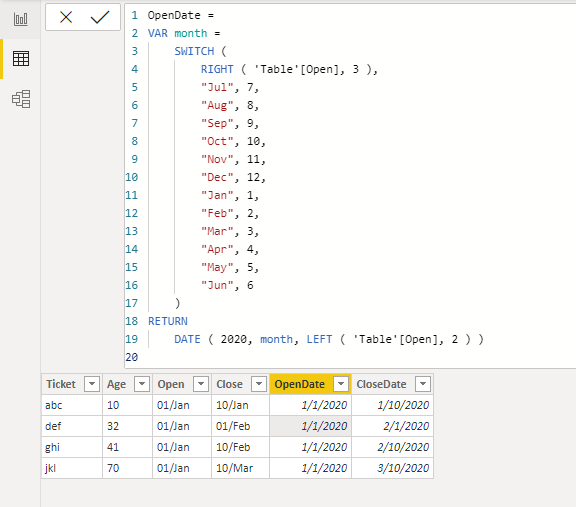
3.Create a calendar table.
Dates =
ADDCOLUMNS (
    CALENDAR ( DATE ( 2020, 1, 1 ), DATE ( 2020, 12, 31 ) ),
    "day", DAY ( [Date] ),
    "Period",
        DAY ( [Date] ) & "/"
            & FORMAT ( [Date], "mmm" )
)
4.Create a new table which is a combination and filtering of the previous two tables.
NewTable =
SUMMARIZE (
    ADDCOLUMNS (
        FILTER (
            CROSSJOIN ( 'Dates', 'Table' ),
            [Date] <= [CloseDate]
                && [Date] >= [OpenDate]
                && [day] = 1
        ),
        "Days by Month",
            IF (
                EOMONTH ( [Date], 0 ) < [CloseDate],
                DAY ( EOMONTH ( [Date], 0 ) ),
                DAY ( [CloseDate] )
            )
    ),
    [Ticket],
    [Period],
    [Days by Month]
)

You can check more details from here.
Best Regards,
Stephen Tao
If this post helps, then please consider Accept it as the solution to help the other members find it more quickly.
- Mark as New
- Bookmark
- Subscribe
- Mute
- Subscribe to RSS Feed
- Permalink
- Report Inappropriate Content
Hi @Anonymous ,
1.My sample data is this.
Ticket | Age | Open | Close |
abc | 10 | 01/Jan | 10/Jan |
def | 32 | 01/Jan | 01/Feb |
ghi | 41 | 01/Jan | 10/Feb |
jkl | 70 | 01/Jan | 10/Mar |
2.Create calculated columns to get Open date and Close date.
OpenDate =
VAR month =
    SWITCH (
        RIGHT ( 'Table'[Open], 3 ),
        "Jul", 7,
        "Aug", 8,
        "Sep", 9,
        "Oct", 10,
        "Nov", 11,
        "Dec", 12,
        "Jan", 1,
        "Feb", 2,
        "Mar", 3,
        "Apr", 4,
        "May", 5,
        "Jun", 6
    )
RETURN
    DATE ( 2020, month, LEFT ( 'Table'[Open], 2 ) )
CloseDate =
VAR month =
SWITCH (
RIGHT ( 'Table'[Close], 3 ),
"Jul", 7,
"Aug", 8,
"Sep", 9,
"Oct", 10,
"Nov", 11,
"Dec", 12,
"Jan", 1,
"Feb", 2,
"Mar", 3,
"Apr", 4,
"May", 5,
"Jun", 6
)
RETURN
DATE ( 2020, month, LEFT ( 'Table'[Close], 2 ) )
3.Create a calendar table.
Dates =
ADDCOLUMNS (
    CALENDAR ( DATE ( 2020, 1, 1 ), DATE ( 2020, 12, 31 ) ),
    "day", DAY ( [Date] ),
    "Period",
        DAY ( [Date] ) & "/"
            & FORMAT ( [Date], "mmm" )
)
4.Create a new table which is a combination and filtering of the previous two tables.
NewTable =
SUMMARIZE (
    ADDCOLUMNS (
        FILTER (
            CROSSJOIN ( 'Dates', 'Table' ),
            [Date] <= [CloseDate]
                && [Date] >= [OpenDate]
                && [day] = 1
        ),
        "Days by Month",
            IF (
                EOMONTH ( [Date], 0 ) < [CloseDate],
                DAY ( EOMONTH ( [Date], 0 ) ),
                DAY ( [CloseDate] )
            )
    ),
    [Ticket],
    [Period],
    [Days by Month]
)
You can check more details from here.
Best Regards,
Stephen Tao
If this post helps, then please consider Accept it as the solution to help the other members find it more quickly.


- Mark as New
- Bookmark
- Subscribe
- Mute
- Subscribe to RSS Feed
- Permalink
- Report Inappropriate Content
Hello @Williamspsouza
you can do this with Power Query as follows:
// Table
let
    Source = Table.FromRows(Json.Document(Binary.Decompress(Binary.FromText("i45WSkxKVtJRMjDUByIjAyMDIMfQAIWjFKsTrZSSmoauDMQxgnGMjcDK0jMysZkGV2ZiCFaWlZ2DTZkxjGMOtDQWAA==", BinaryEncoding.Base64), Compression.Deflate)), let _t = ((type nullable text) meta [Serialized.Text = true]) in type table [Ticket = _t, Open = _t, Close = _t, Age = _t]),
    #"Changed Type" = Table.TransformColumnTypes(Source,{{"Ticket", type text}, {"Open", type date}, {"Close", type date}, {"Age", Int64.Type}}),
    #"Added Custom" = Table.AddColumn(#"Changed Type", "Custom", each {Number.From([Open]).. Number.From([Close])}),
    #"Expanded Custom" = Table.ExpandListColumn(#"Added Custom", "Custom"),
    #"Changed Type1" = Table.TransformColumnTypes(#"Expanded Custom",{{"Custom", type date}}),
    #"Inserted Month" = Table.AddColumn(#"Changed Type1", "Month", each Date.Month([Custom]), Int64.Type),
    #"Added Custom1" = Table.AddColumn(#"Inserted Month", "Day", each 1),
    #"Changed Type2" = Table.TransformColumnTypes(#"Added Custom1",{{"Day", Int64.Type}}),
    #"Grouped Rows" = Table.Group(#"Changed Type2", {"Ticket", "Month"}, {{"Sum", each List.Sum([Day]), type nullable number}}),
    #"Added Custom2" = Table.AddColumn(#"Grouped Rows", "Period", each #date(2020,[Month],1)),
    #"Removed Columns" = Table.RemoveColumns(#"Added Custom2",{"Month"}),
    #"Reordered Columns" = Table.ReorderColumns(#"Removed Columns",{"Ticket", "Period", "Sum"}),
    #"Changed Type3" = Table.TransformColumnTypes(#"Reordered Columns",{{"Period", type date}})
in
    #"Changed Type3"
FrankAT (Proud to be a Datanaut)


- Mark as New
- Bookmark
- Subscribe
- Mute
- Subscribe to RSS Feed
- Permalink
- Report Inappropriate Content
Hi,
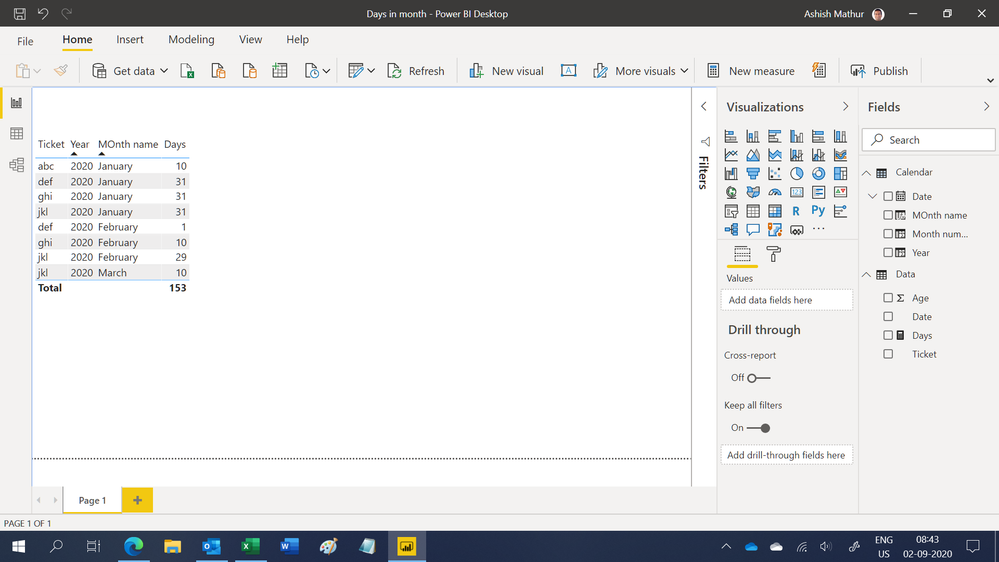
Download my PBI file from here.
Hope this helps.
Regards,
Ashish Mathur
http://www.ashishmathur.com
https://www.linkedin.com/in/excelenthusiasts/

- Mark as New
- Bookmark
- Subscribe
- Mute
- Subscribe to RSS Feed
- Permalink
- Report Inappropriate Content
@Anonymous - Check out Open Tickets. It will be the same basic concept. https://community.powerbi.com/t5/Quick-Measures-Gallery/Open-Tickets/m-p/409364#M147
Follow on LinkedIn
@ me in replies or I'll lose your thread!!!
Instead of a Kudo, please vote for this idea
Become an expert!: Enterprise DNA
External Tools: MSHGQM
YouTube Channel!: Microsoft Hates Greg
Latest book!: DAX For Humans
DAX is easy, CALCULATE makes DAX hard...
- Mark as New
- Bookmark
- Subscribe
- Mute
- Subscribe to RSS Feed
- Permalink
- Report Inappropriate Content
I appreciate the answer but it doesn’t answer my question. How long has a ticket been open each month?
- Mark as New
- Bookmark
- Subscribe
- Mute
- Subscribe to RSS Feed
- Permalink
- Report Inappropriate Content
Hi,
Have you checked my result?
Regards,
Ashish Mathur
http://www.ashishmathur.com
https://www.linkedin.com/in/excelenthusiasts/
Helpful resources

FabCon & SQLCon – Barcelona 2026
Join us in Barcelona for FabCon and SQLCon, the Fabric, Power BI, SQL, and AI community event. Save €200 with code FABCMTY200.

Data Days 2026
Join Fabric Data Days 2026: 60 days of free live/on-demand sessions, challenges, study groups, and certification opportunities.

Power BI DataViz World Championships - June 2026
A new Power BI DataViz World Championship is coming this June! Don't miss out on submitting your entry.

| User | Count |
|---|---|
| 23 | |
| 22 | |
| 18 | |
| 17 | |
| 13 |


| User | Count |
|---|---|
| 63 | |
| 44 | |
| 42 | |
| 40 | |
| 39 |


