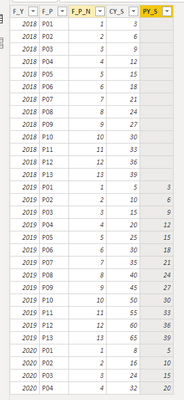
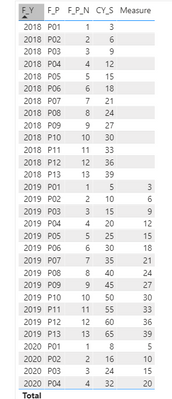
hello All,
I am trying to calculate same period last year by using Custom calender.
My calender looks like below table.
Year period StartDate EndDate
| 2019 | P01 | 30-12-2018 00:00:00 | 26-01-2019 00:00:00 |
| 2019 | P02 | 27-01-2019 00:00:00 | 23-02-2019 00:00:00 |
| 2019 | P03 | 24-02-2019 00:00:00 | 23-03-2019 00:00:00 |
| 2019 | P04 | 24-03-2019 00:00:00 | 20-04-2019 00:00:00 |
| 2019 | P05 | 21-04-2019 00:00:00 | 18-05-2019 00:00:00 |
| 2019 | P06 | 19-05-2019 00:00:00 | 15-06-2019 00:00:00 |
| 2019 | P07 | 16-06-2019 00:00:00 | 13-07-2019 00:00:00 |
| 2019 | P08 | 14-07-2019 00:00:00 | 10-08-2019 00:00:00 |
| 2019 | P09 | 11-08-2019 00:00:00 | 07-09-2019 00:00:00 |
| 2019 | P10 | 08-09-2019 00:00:00 | 05-10-2019 00:00:00 |
| 2019 | P11 | 06-10-2019 00:00:00 | 02-11-2019 00:00:00 |
| 2019 | P12 | 03-11-2019 00:00:00 | 30-11-2019 00:00:00 |
| 2019 | P13 | 01-12-2019 00:00:00 | 28-12-2019 00:00:00 |
| 2020 | P01 | 29-12-2019 00:00:00 | 25-01-2020 00:00:00 |
| 2020 | P02 | 26-01-2020 00:00:00 | 22-02-2020 00:00:00 |
| 2020 | P03 | 23-02-2020 00:00:00 | 21-03-2020 00:00:00 |
| 2020 | P04 | 22-03-2020 00:00:00 | 18-04-2020 00:00:00 |
| 2020 | P05 | 19-04-2020 00:00:00 | 16-05-2020 00:00:00 |
| 2020 | P06 | 17-05-2020 00:00:00 | 13-06-2020 00:00:00 |
| 2020 | P07 | 14-06-2020 00:00:00 | 11-07-2020 00:00:00 |
| 2020 | P08 | 12-07-2020 00:00:00 | 08-08-2020 00:00:00 |
| 2020 | P09 | 09-08-2020 00:00:00 | 05-09-2020 00:00:00 |
| 2020 | P10 | 06-09-2020 00:00:00 | 03-10-2020 00:00:00 |
| 2020 | P11 | 04-10-2020 00:00:00 | 31-10-2020 00:00:00 |
| 2020 | P12 | 01-11-2020 00:00:00 | 28-11-2020 00:00:00 |
| 2020 | P13 | 29-11-2020 00:00:00 | 26-12-2020 00:00:00 |
As per the above table, every PERIOD is of 4 weeks, and one FY may have 13 periods.
I have sales data as below image.
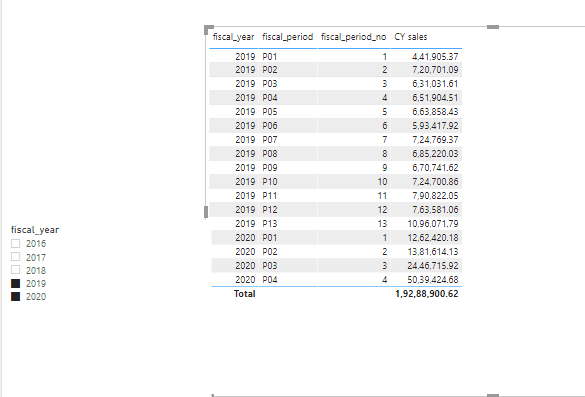
for 2020, currently i have 4 periods of sales data only, but when i do the sameperiodlast year, then it will take whole sales sum of 2019 which is not fare.
so i want to compare what ever the periods sales values we have in current FY, those no of periods should be compared in every previous year.
Can anyone please. suggest me.
Thanks,
Mohan V.