FabCon is coming to Atlanta
Join us at FabCon Atlanta from March 16 - 20, 2026, for the ultimate Fabric, Power BI, AI and SQL community-led event. Save $200 with code FABCOMM.
Register now!- Power BI forums
- Get Help with Power BI
- Desktop
- Service
- Report Server
- Power Query
- Mobile Apps
- Developer
- DAX Commands and Tips
- Custom Visuals Development Discussion
- Health and Life Sciences
- Power BI Spanish forums
- Translated Spanish Desktop
- Training and Consulting
- Instructor Led Training
- Dashboard in a Day for Women, by Women
- Galleries
- Data Stories Gallery
- Themes Gallery
- Contests Gallery
- QuickViz Gallery
- Quick Measures Gallery
- Visual Calculations Gallery
- Notebook Gallery
- Translytical Task Flow Gallery
- TMDL Gallery
- R Script Showcase
- Webinars and Video Gallery
- Ideas
- Custom Visuals Ideas (read-only)
- Issues
- Issues
- Events
- Upcoming Events
The Power BI Data Visualization World Championships is back! Get ahead of the game and start preparing now! Learn more
- Power BI forums
- Forums
- Get Help with Power BI
- Desktop
- Re: Adding an integer to a date results in strange...
- Subscribe to RSS Feed
- Mark Topic as New
- Mark Topic as Read
- Float this Topic for Current User
- Bookmark
- Subscribe
- Printer Friendly Page

- Mark as New
- Bookmark
- Subscribe
- Mute
- Subscribe to RSS Feed
- Permalink
- Report Inappropriate Content
Adding a whole number to a date results in weird results
Hi BI Gurus!
I have two tables, related 1 - many.
Table1, DATES Table2, Whole Numbers
06/04/2020 3
Using NewDate = SUMX('table1', 'table1[DATES] + DAY('Table2'[Whole Numbers]))
Results: 06/14/4068
Desired Result: 06/07/2020
What did I miss? I also tried DATEADD and and recieved errors.
Any help is geatly appreciated.
Solved! Go to Solution.


- Mark as New
- Bookmark
- Subscribe
- Mute
- Subscribe to RSS Feed
- Permalink
- Report Inappropriate Content
if I understand right.
Do you want a DATE column in TABLE1 to add values that are calculated by a measure that gets values from TABLE2?
answer: It is NOT possible directly.
DAX formulas do not allow you to combine column data with measurements sirectally without using aggregations (e.g. SUMX).
rethink how to address the problem, such as:
- That calculations be made at the level of measures or columns in both cases.
- Create a calculated table with Summarize that allows you to convert the measure to a column
- Mark as New
- Bookmark
- Subscribe
- Mute
- Subscribe to RSS Feed
- Permalink
- Report Inappropriate Content
I see two mistakes in your problem
- You add to a date a number of X days. you shouldn't do it like this. you must use aggregation functions like Dateadd
- You use the DAY function for inside it has a field of type number. The DAY function must have a date-type field inside.


- Mark as New
- Bookmark
- Subscribe
- Mute
- Subscribe to RSS Feed
- Permalink
- Report Inappropriate Content
Hi @kwong
here a solution with parameter:
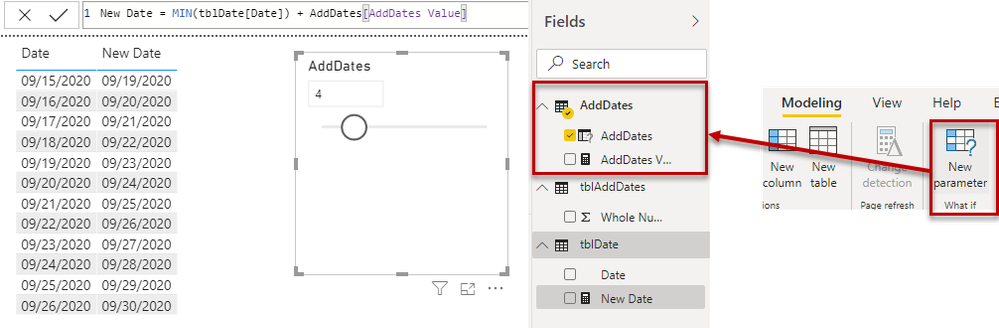
With kind regards from the town where the legend of the 'Pied Piper of Hamelin' is at home
FrankAT (Proud to be a Datanaut)
- Mark as New
- Bookmark
- Subscribe
- Mute
- Subscribe to RSS Feed
- Permalink
- Report Inappropriate Content
Thanks! Will this work for adding 'random' data from table2[duration]?


- Mark as New
- Bookmark
- Subscribe
- Mute
- Subscribe to RSS Feed
- Permalink
- Report Inappropriate Content
@kwong ,
First of all, day function will result in error as it expects date field and it receives whole number.
I created demo data with same structure.
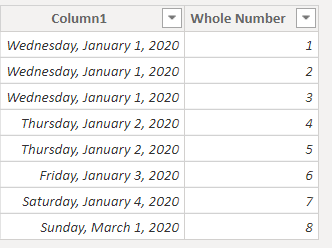
Table1 = date table, Table2 = table with date column and whole number column.
Relationship is based on date column, 1 to many.
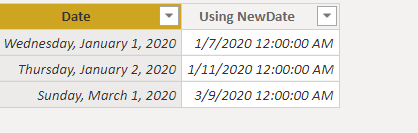
In Table1 i created new column: Using NewDate = CALCULATE(SUM(Table2[Whole Number]))
For each day it calculates total of column Whole number from Table2.
And then i add calculation to add this number of days to date column.
So final calculation in column is: Using NewDate = CALCULATE(SUM(Table2[Whole Number])) + Table1[Date]
This is data in Table2:
- Mark as New
- Bookmark
- Subscribe
- Mute
- Subscribe to RSS Feed
- Permalink
- Report Inappropriate Content
Hi, Thanks for the quick response. This looks pretty close. I think I should provide more context...
Table2[Duration] is a Measure from a column in a third table used to calculate averages of groups of distinct values two other columns in table3.
Table1[Date] Table2[Duration]
7/31/2020 0
6/4/2020 3
5/5/2020 3
6/1/2020 12
8/6/2020 9
9/8/2020 11
8/26/2020
9/2/2020 2
The desire is to add the values in Table2[Duration] to the Dates in Table1[Date]
Return: Table1 or Table2 [Projection] (blanks may be ignored)
Any ideas?
- Mark as New
- Bookmark
- Subscribe
- Mute
- Subscribe to RSS Feed
- Permalink
- Report Inappropriate Content
if I understand right.
Do you want a DATE column in TABLE1 to add values that are calculated by a measure that gets values from TABLE2?
answer: It is NOT possible directly.
DAX formulas do not allow you to combine column data with measurements sirectally without using aggregations (e.g. SUMX).
rethink how to address the problem, such as:
- That calculations be made at the level of measures or columns in both cases.
- Create a calculated table with Summarize that allows you to convert the measure to a column
- Mark as New
- Bookmark
- Subscribe
- Mute
- Subscribe to RSS Feed
- Permalink
- Report Inappropriate Content
Thanks! I think I will try to create a new table from infomration from two seprate tables.
table_current and table_past
table_combined will have [date] from table_current and average_duration from table_past
hopefully this will be fairly straight forward.
any suggestions are welcome! you folks are great!

Helpful resources

Power BI Dataviz World Championships
The Power BI Data Visualization World Championships is back! Get ahead of the game and start preparing now!

Power BI Monthly Update - December 2025
Check out the December 2025 Power BI Holiday Recap!

FabCon Atlanta 2026
Join us at FabCon Atlanta, March 16-20, for the ultimate Fabric, Power BI, AI and SQL community-led event. Save $200 with code FABCOMM.

| User | Count |
|---|---|
| 39 | |
| 38 | |
| 38 | |
| 28 | |
| 27 |


| User | Count |
|---|---|
| 124 | |
| 88 | |
| 73 | |
| 66 | |
| 65 |


