Join us at FabCon Atlanta from March 16 - 20, 2026, for the ultimate Fabric, Power BI, AI and SQL community-led event. Save $200 with code FABCOMM.
Register now!The Power BI Data Visualization World Championships is back! Get ahead of the game and start preparing now! Learn more
Hi All.
I have a requirement something similar to below:
Data:
Emp Group 1 Group 2 Group 3
| A | Group 1 | ||
| B | Group 2 | ||
| C | Group 1 | ||
| D | Group 2 | ||
| E | Group 3 | ||
| F | Group 1 |
I need to show this data in line and stacked column chart with X Axis as group 1, group 2, group 3 and Y axis as count against each group.
Thanks in advance
Solved! Go to Solution.
Hi @Anonymous ,
Please check the following step as below.
1. Unpivot the table in power query. Please check the M code for your reference.
let
Source = Table.FromRows(Json.Document(Binary.Decompress(Binary.FromText("i45WclTSUXIvyi8tUDAEskAoVidayQnChkgYwUSdsap1warWFaoCJmEMFnXDNCEWAA==", BinaryEncoding.Base64), Compression.Deflate)), let _t = ((type text) meta [Serialized.Text = true]) in type table [Emp = _t, #"Group 1" = _t, #"Group 2" = _t, #"Group 3" = _t]),
#"Changed Type" = Table.TransformColumnTypes(Source,{{"Emp", type text}, {"Group 1", type text}, {"Group 2", type text}, {"Group 3", type text}}),
#"Unpivoted Columns" = Table.UnpivotOtherColumns(#"Changed Type", {}, "Attribute", "Value"),
#"Filtered Rows" = Table.SelectRows(#"Unpivoted Columns", each ([Attribute] <> "Emp"))
in
#"Filtered Rows"
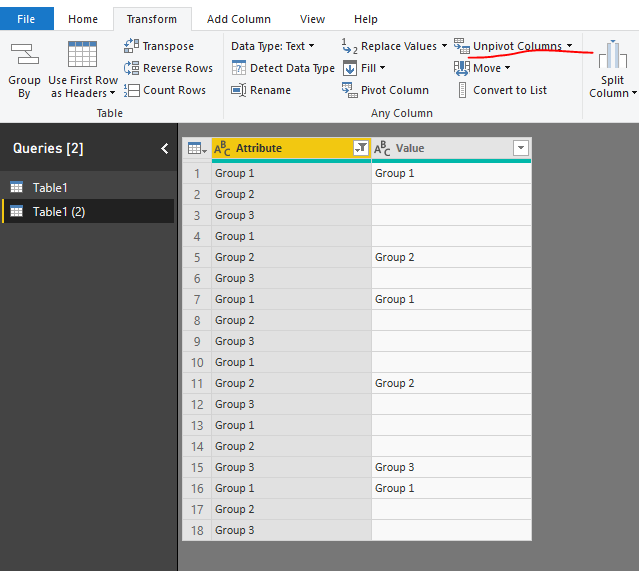
2. Then create a measure as below and add it to the line chart to get the result as we need.
Measure = CALCULATE(COUNTROWS('Table1 (2)'),FILTER('Table1 (2)','Table1 (2)'[Value]<>BLANK()))
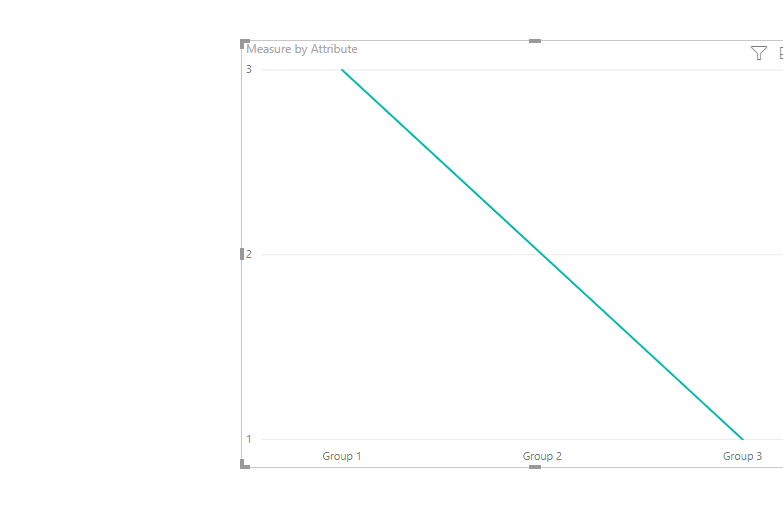
Please check the pbix as attached.
Regards,
Frank
Hi @Anonymous ,
Please check the following step as below.
1. Unpivot the table in power query. Please check the M code for your reference.
let
Source = Table.FromRows(Json.Document(Binary.Decompress(Binary.FromText("i45WclTSUXIvyi8tUDAEskAoVidayQnChkgYwUSdsap1warWFaoCJmEMFnXDNCEWAA==", BinaryEncoding.Base64), Compression.Deflate)), let _t = ((type text) meta [Serialized.Text = true]) in type table [Emp = _t, #"Group 1" = _t, #"Group 2" = _t, #"Group 3" = _t]),
#"Changed Type" = Table.TransformColumnTypes(Source,{{"Emp", type text}, {"Group 1", type text}, {"Group 2", type text}, {"Group 3", type text}}),
#"Unpivoted Columns" = Table.UnpivotOtherColumns(#"Changed Type", {}, "Attribute", "Value"),
#"Filtered Rows" = Table.SelectRows(#"Unpivoted Columns", each ([Attribute] <> "Emp"))
in
#"Filtered Rows"
2. Then create a measure as below and add it to the line chart to get the result as we need.
Measure = CALCULATE(COUNTROWS('Table1 (2)'),FILTER('Table1 (2)','Table1 (2)'[Value]<>BLANK()))
Please check the pbix as attached.
Regards,
Frank
Thanks a lot Frank. This really helped![]()
The Power BI Data Visualization World Championships is back! Get ahead of the game and start preparing now!
| User | Count |
|---|---|
| 66 | |
| 47 | |
| 41 | |
| 36 | |
| 23 |
| User | Count |
|---|---|
| 189 | |
| 124 | |
| 106 | |
| 78 | |
| 52 |