Don't miss your chance to take the Fabric Data Engineer (DP-700) exam on us!
Learn moreWe've captured the moments from FabCon & SQLCon that everyone is talking about, and we are bringing them to the community, live and on-demand. Starts on April 14th. Register now
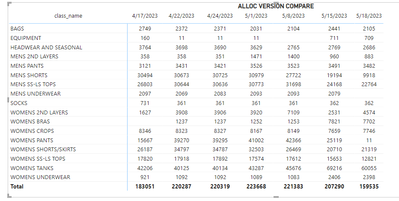
We are are trying to see % change of each load time side by side and add it to this visual , aslo would like to have option to choose two load times to compate too .
example :want to comapte load tme of 5/18/2023 to 4/24/2023.
All data coming from one data set and no measures has been used.
@FreemanZ Thank you for reply, to explain more and be more clear :
I want to create the below table in Power BI Matrix, so I have week number and Qty , then want to use dax to create unit variance and % variance .
| wk 20 | V U | V % | wk 21 | V U | V % | wk 22 | V U | V % | wk 23 | V U | V % | wk 24 | V U |
| 60 | 0 | 0% | 70 | 10 | 17% | 45 | -25 | -36% | 1 | -44 | -98% | 200 | 199 |
Not sure if fully get you.
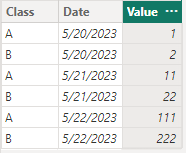
Supposing you have a data table like:
try to
1) plot a slicer with a calculated table like:
slicer = VALUES(data[Date])2) plot a table visual with class column and a measure like:
measure =
CALCULATE(
SUM(data[Value]),
data[Date]=MAX(slicer[Date])
)
-
CALCULATE(
SUM(data[Value]),
data[Date]=MIN(slicer[Date])
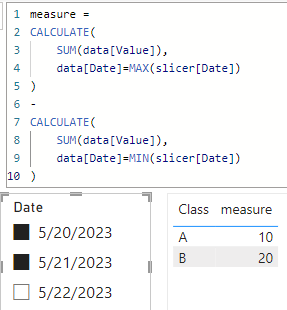
)it worked like:
If you have recently started exploring Fabric, we'd love to hear how it's going. Your feedback can help with product improvements.
A new Power BI DataViz World Championship is coming this June! Don't miss out on submitting your entry.
Share feedback directly with Fabric product managers, participate in targeted research studies and influence the Fabric roadmap.
| User | Count |
|---|---|
| 9 | |
| 8 | |
| 3 | |
| 2 | |
| 2 |
| User | Count |
|---|---|
| 23 | |
| 14 | |
| 10 | |
| 6 | |
| 5 |