FabCon is coming to Atlanta
Join us at FabCon Atlanta from March 16 - 20, 2026, for the ultimate Fabric, Power BI, AI and SQL community-led event. Save $200 with code FABCOMM.
Register now!- Power BI forums
- Get Help with Power BI
- Desktop
- Service
- Report Server
- Power Query
- Mobile Apps
- Developer
- DAX Commands and Tips
- Custom Visuals Development Discussion
- Health and Life Sciences
- Power BI Spanish forums
- Translated Spanish Desktop
- Training and Consulting
- Instructor Led Training
- Dashboard in a Day for Women, by Women
- Galleries
- Data Stories Gallery
- Themes Gallery
- Contests Gallery
- QuickViz Gallery
- Quick Measures Gallery
- Visual Calculations Gallery
- Notebook Gallery
- Translytical Task Flow Gallery
- TMDL Gallery
- R Script Showcase
- Webinars and Video Gallery
- Ideas
- Custom Visuals Ideas (read-only)
- Issues
- Issues
- Events
- Upcoming Events
The Power BI Data Visualization World Championships is back! Get ahead of the game and start preparing now! Learn more
- Power BI forums
- Forums
- Get Help with Power BI
- DAX Commands and Tips
- Re: accumulate (distinctivly) the amount of client...
- Subscribe to RSS Feed
- Mark Topic as New
- Mark Topic as Read
- Float this Topic for Current User
- Bookmark
- Subscribe
- Printer Friendly Page


- Mark as New
- Bookmark
- Subscribe
- Mute
- Subscribe to RSS Feed
- Permalink
- Report Inappropriate Content
accumulate (distinctivly) the amount of clients who have stock bigger than 0
Hi,
I need to create a meausure to incorporate in the TABLE visualization (which varies according to the filter from the table DATE) so that I can accumulate (count distinctivly) the amount of clients who have stock > 0. If the sum in the stock column is more than 1, it should count it as just one: example: if for client D the sum of stock column is 2 it should count as only one client.
I usea a Table Dates (column: year-month) to filter the main visualization:
TableDates = ADDCOLUMNS ( CALENDAR (FIRSTDATE(Sheet1[DATE]), TODAY()), "year", YEAR ( [Date] ), "MonthNumber", FORMAT ( [Date], "MM" ), "year-month", FORMAT ( [Date], "YYYY-MM" ), "month-year", FORMAT ( [Date], "MM-'YY" ) )
This is the main table:
| Client | DATE | Category | product | stock |
| A | 30-ene-20 | Category1 | 1001 | 1 |
| A | 8-may-20 | Category1 | 1001 | -1 |
| A | 10-sep-20 | Category1 | 1002 | 1 |
| A | 1-nov-20 | Category1 | 1002 | -1 |
| A | 8-nov-20 | Category1 | 1003 | 1 |
| A | 8-may-21 | Category1 | 1003 | -1 |
| A | 11-jun-21 | Category1 | 1004 | 1 |
| A | 8-nov-21 | Category1 | 1004 | -1 |
| A | 11-dic-21 | Category1 | 1005 | 1 |
| B | 30-ene-20 | Category2 | 3001 | 1 |
| B | 15-mar-20 | Category2 | 3001 | -1 |
| B | 30-jul-20 | Category2 | 3002 | 1 |
| B | 30-jul-20 | Category2 | 3002 | -1 |
| C | 7-feb-20 | Category3 | 2001 | 1 |
| C | 7-ago-20 | Category3 | 2001 | -1 |
| C | 7-feb-21 | Category3 | 2002 | 1 |
| C | 16-abr-21 | Category3 | 2002 | -1 |
| C | 7-ago-21 | Category3 | 2003 | 1 |
| C | 7-feb-22 | Category3 | 2003 | -1 |
| C | 15-abr-22 | Category3 | 2004 | 1 |
| D | 30-jul-20 | Category1 | 4001 | 1 |
| D | 30-ene-21 | Category1 | 4001 | -1 |
| D | 30-jul-21 | Category1 | 4002 | 1 |
| D | 3-nov-21 | Category1 | 4002 | -1 |
| D | 3-nov-21 | Category1 | 4003 | 1 |
| D | 2-may-22 | Category1 | 4004 | 1 |
| D | 3-may-22 | Category1 | 4005 | 1 |
I need this results:
| Category | Clients |
| Category1 | 2 |
| Category2 | 0 |
| Category3 | 1 |
| total | 3 |
Solved! Go to Solution.


- Mark as New
- Bookmark
- Subscribe
- Mute
- Subscribe to RSS Feed
- Permalink
- Report Inappropriate Content
- Mark as New
- Bookmark
- Subscribe
- Mute
- Subscribe to RSS Feed
- Permalink
- Report Inappropriate Content
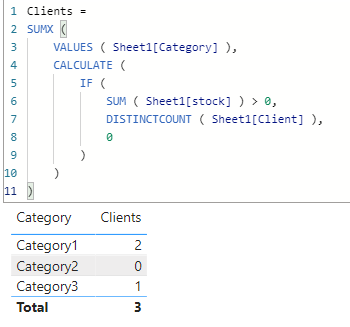
Hi @pg1980
Please use
Clients =
SUMX (
    VALUES ( Sheet1[Category] ),
    CALCULATE (
        IF (
            SUM ( Sheet1[stock] ) > 0,
            DISTINCTCOUNT ( Sheet1[Client] ),
            0
        )
    )
)
- Mark as New
- Bookmark
- Subscribe
- Mute
- Subscribe to RSS Feed
- Permalink
- Report Inappropriate Content
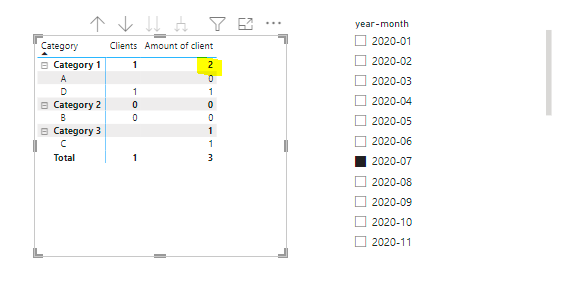
Thank you @tamerj1 ! but if i have to accumulate the active clients, and I use a filter ("year-month") in "2020-07" I have this result:
- Mark as New
- Bookmark
- Subscribe
- Mute
- Subscribe to RSS Feed
- Permalink
- Report Inappropriate Content
- Mark as New
- Bookmark
- Subscribe
- Mute
- Subscribe to RSS Feed
- Permalink
- Report Inappropriate Content
Hi! What I need to do is to accumulate the quantity of active clients month by month. I have used your measure "Clients" by the measure described before ("Amount of client") and for the "2020-07" it´s adding Client A, but it shouldn´t. I am also using a Table Dates. Do you think you could help me? Has it ever happened to you?
- Mark as New
- Bookmark
- Subscribe
- Mute
- Subscribe to RSS Feed
- Permalink
- Report Inappropriate Content
Noted @pg1980
please try
Clients =
VAR CurrentDate =
    MAX ( DateTable[Date] )
RETURN
    CALCULATE (
        SUMX (
            VALUES ( Sheet1[Category] ),
            CALCULATE (
                IF ( SUM ( Sheet1[stock] ) > 0, DISTINCTCOUNT ( Sheet1[Client] ), 0 )
            )
        ),
        DateTable[Date] <= CurrentDate
)- Mark as New
- Bookmark
- Subscribe
- Mute
- Subscribe to RSS Feed
- Permalink
- Report Inappropriate Content
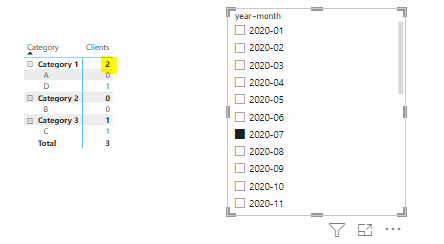
No, sorry. It has the same problem. It is counting one more client (Client A is cero and client D is 1, so category 1 must be 1)
- Mark as New
- Bookmark
- Subscribe
- Mute
- Subscribe to RSS Feed
- Permalink
- Report Inappropriate Content
If not working then we need the cross join with date
Clients =
VAR CurrentDate =
    MAX ( DateTable[Date] )
RETURN
    CALCULATE (
        SUMX (
            SUMMARIZE ( Sheet1, Sheet1[Category], Sheet1[Client] ),
            CALCULATE (
                IF ( SUM ( Sheet1[stock] ) > 0, DISTINCTCOUNT ( Sheet1[Client] ), 0 )
            )
        ),
        DateTable[Date] <= CurrentDate
    )
- Mark as New
- Bookmark
- Subscribe
- Mute
- Subscribe to RSS Feed
- Permalink
- Report Inappropriate Content
Its duplicated Sheet1[Category] in SUMMARIZE , should I change to an other parameter?
- Mark as New
- Bookmark
- Subscribe
- Mute
- Subscribe to RSS Feed
- Permalink
- Report Inappropriate Content
Yes change to Client
- Mark as New
- Bookmark
- Subscribe
- Mute
- Subscribe to RSS Feed
- Permalink
- Report Inappropriate Content
If not working please try
Clients =
VAR CurrentDate =
    MAX ( DateTable[Date] )
RETURN
    CALCULATE (
        SUMX (
            CROSSJOIN (
                VALUES ( DateTable[Date] ),
                SUMMARIZE ( Sheet1, Sheet1[Category], Sheet1[Client] )
            ),
            CALCULATE (
                IF ( SUM ( Sheet1[stock] ) > 0, DISTINCTCOUNT ( Sheet1[Client] ), 0 )
            )
        ),
        DateTable[Date] <= CurrentDate
)- Mark as New
- Bookmark
- Subscribe
- Mute
- Subscribe to RSS Feed
- Permalink
- Report Inappropriate Content
It is working with this measure:
- Mark as New
- Bookmark
- Subscribe
- Mute
- Subscribe to RSS Feed
- Permalink
- Report Inappropriate Content
- Mark as New
- Bookmark
- Subscribe
- Mute
- Subscribe to RSS Feed
- Permalink
- Report Inappropriate Content
In this case if you sum the "stock" column, the answer for Category 1 is 4 but i need to count distinctivly the clients. So in Category 1, you have 2 clients: A an D.
for example: if for client D the sum of stock column is 2 it should count as only one client

Helpful resources

Power BI Dataviz World Championships
The Power BI Data Visualization World Championships is back! Get ahead of the game and start preparing now!

Power BI Monthly Update - November 2025
Check out the November 2025 Power BI update to learn about new features.

FabCon Atlanta 2026
Join us at FabCon Atlanta, March 16-20, for the ultimate Fabric, Power BI, AI and SQL community-led event. Save $200 with code FABCOMM.

| User | Count |
|---|---|
| 20 | |
| 10 | |
| 9 | |
| 4 | |
| 4 |


| User | Count |
|---|---|
| 32 | |
| 31 | |
| 18 | |
| 12 | |
| 11 |


