Join us at FabCon Vienna from September 15-18, 2025
The ultimate Fabric, Power BI, SQL, and AI community-led learning event. Save €200 with code FABCOMM.
Get registered- Power BI forums
- Get Help with Power BI
- Desktop
- Service
- Report Server
- Power Query
- Mobile Apps
- Developer
- DAX Commands and Tips
- Custom Visuals Development Discussion
- Health and Life Sciences
- Power BI Spanish forums
- Translated Spanish Desktop
- Training and Consulting
- Instructor Led Training
- Dashboard in a Day for Women, by Women
- Galleries
- Data Stories Gallery
- Themes Gallery
- Contests Gallery
- Quick Measures Gallery
- Notebook Gallery
- Translytical Task Flow Gallery
- TMDL Gallery
- R Script Showcase
- Webinars and Video Gallery
- Ideas
- Custom Visuals Ideas (read-only)
- Issues
- Issues
- Events
- Upcoming Events
Enhance your career with this limited time 50% discount on Fabric and Power BI exams. Ends August 31st. Request your voucher.
- Power BI forums
- Forums
- Get Help with Power BI
- DAX Commands and Tips
- Re: How to filter a table based on a column's high...
- Subscribe to RSS Feed
- Mark Topic as New
- Mark Topic as Read
- Float this Topic for Current User
- Bookmark
- Subscribe
- Printer Friendly Page


- Mark as New
- Bookmark
- Subscribe
- Mute
- Subscribe to RSS Feed
- Permalink
- Report Inappropriate Content
How to filter a table based on a column's highest value
Hi,
I am trying to calculate the total quantity by Quality from a table called "Data", but filtering on the highest value in Period (in this case, 201906). The purpose is to calculate the variance for each quality (highest period/lowest period).
In other words, I would like to get for each product Quantity [Period 201906] / Quantity [Period 201902]
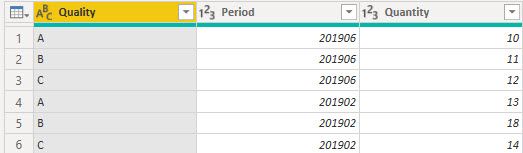
I have tried different formulas but I'm struggling with the filter context.
Can anyone help me?
Thanks!
Solved! Go to Solution.
- Mark as New
- Bookmark
- Subscribe
- Mute
- Subscribe to RSS Feed
- Permalink
- Report Inappropriate Content

- Mark as New
- Bookmark
- Subscribe
- Mute
- Subscribe to RSS Feed
- Permalink
- Report Inappropriate Content
Best
D.
- Mark as New
- Bookmark
- Subscribe
- Mute
- Subscribe to RSS Feed
- Permalink
- Report Inappropriate Content
How would you proceed, then, with Query M?
- Mark as New
- Bookmark
- Subscribe
- Mute
- Subscribe to RSS Feed
- Permalink
- Report Inappropriate Content
- Mark as New
- Bookmark
- Subscribe
- Mute
- Subscribe to RSS Feed
- Permalink
- Report Inappropriate Content
Thanks @Anonymous and @Greg for your solutions. My description of the issue is probably not accurate enough. What I am looking for is not retrieving the minimum quantity for each quantity. I want to retrieve the quantity for the Maximum value in "Period".
So for Quality "A", I want to retrieve the quantity where the value "Period" is the highest, so 10, not 13.
Then I would like to do the same for the minimum Period (so retrieve Quantity 5 for Quality A in @Anonymous 's example).
In the end, I would divide the Quantity for the highest Period by the Quantity for the lowest Period, for each Quality. That would give me an index, which is the scope of all the above.
I thought that DAX was the right language to solve this question but I didn't figure out how, despite may trials.
Thanks again for your help!
- Mark as New
- Bookmark
- Subscribe
- Mute
- Subscribe to RSS Feed
- Permalink
- Report Inappropriate Content
Best
D.
- Mark as New
- Bookmark
- Subscribe
- Mute
- Subscribe to RSS Feed
- Permalink
- Report Inappropriate Content
OK. So you need another table (created in PQ) that for each quality will store the quantities for the latest and oldest period.
I'll post a link to a file shortly.
Best
Dare
- Mark as New
- Bookmark
- Subscribe
- Mute
- Subscribe to RSS Feed
- Permalink
- Report Inappropriate Content
Yes, I think that should be a way to go. 🙂


- Mark as New
- Bookmark
- Subscribe
- Mute
- Subscribe to RSS Feed
- Permalink
- Report Inappropriate Content
Create a DAX formula that goes something like this:
Measure IsHighest =
  VAR __table = SUMMARIZE(ALLSELECTED('Table'),[Quality], [Period],"__Quantity",SUM([Quantity]))
  VAR __max = MAXX(__table,[__Quantity])
  VAR __period = MAXX(FILTER(__table,[__Quantity] = __max),[Period])
RETURN
  IF(MAX([Period]) = __period,1,0)
Then just fiilter on this being 1
Follow on LinkedIn
@ me in replies or I'll lose your thread!!!
Instead of a Kudo, please vote for this idea
Become an expert!: Enterprise DNA
External Tools: MSHGQM
YouTube Channel!: Microsoft Hates Greg
Latest book!: DAX For Humans
DAX is easy, CALCULATE makes DAX hard...
Helpful resources

Power BI Monthly Update - August 2025
Check out the August 2025 Power BI update to learn about new features.

Fabric Community Update - August 2025
Find out what's new and trending in the Fabric community.

| User | Count |
|---|---|
| 11 | |
| 8 | |
| 6 | |
| 6 | |
| 6 |


| User | Count |
|---|---|
| 23 | |
| 14 | |
| 13 | |
| 10 | |
| 8 |


