Get Fabric or SQL Certified for Free.
Get certified for free when you join Fabric Data Days 2026 and dive into Fabric, Power BI, SQL, AI, and other essential data skills.
Join now60 Days of Data Days! Live and on-demand sessions, challenges, study groups and more! And it's all FREE!. Join now. Learn more
- Microsoft Fabric Community
- Fabric community blogs
- Power BI Community Blog
- Customer Retention Part 2: Period over Period Rete...
- Subscribe to RSS Feed
- Mark as New
- Mark as Read
- Bookmark
- Subscribe
- Printer Friendly Page
- Report Inappropriate Content

- Subscribe to RSS Feed
- Mark as New
- Mark as Read
- Bookmark
- Subscribe
- Printer Friendly Page
- Report Inappropriate Content
Objective:
The period over Period Retention is a comparison of one period vs another period. These periods are heterogeneous. The definition of the new retained and lost customers is only based on 2 periods of data i.e. like the customer did not visit in the last 3 months but his last visit was 12 months before. Basically, he did not come in 9 months before the above 3-month period.
This Period: Last 3 months rolling
Last/ previous period: Last 9 Months before the above 3 months
For e.g.: Consider the current month-year as September-2020. The current period or THIS PERIOD is 3 months i.e. June 2020 –August 2020 and the LAST PERIOD or previous period will be September 2019-May 2020.
New: Arrival of a customer for the first time in this period (here, the Last 3-month is considered as one period) is a new customer. Here, we won’t get any sales data from this customer for the last period (i.e. 9-month before this period (3-month)).
Lost: If a customer had visited the store last period (in last 12-months other than last 3-month) but did not visit in this period of 3-month, then we call him a Lost customer. This means that in this period there was no sale from this customer. However, there was a sale recorded by the same customer the previous period.
Retain: The customer who visited both periods (i.e. Last Period and This period). There will be sales data of this customer for this period and last Period.
Implementation
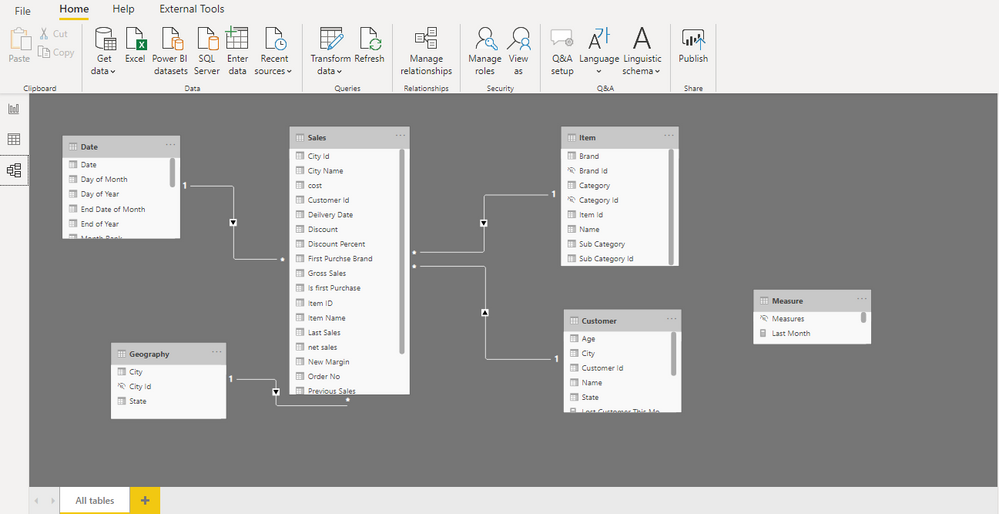
We have 4 tables – Sales, Customer, Geography and Item
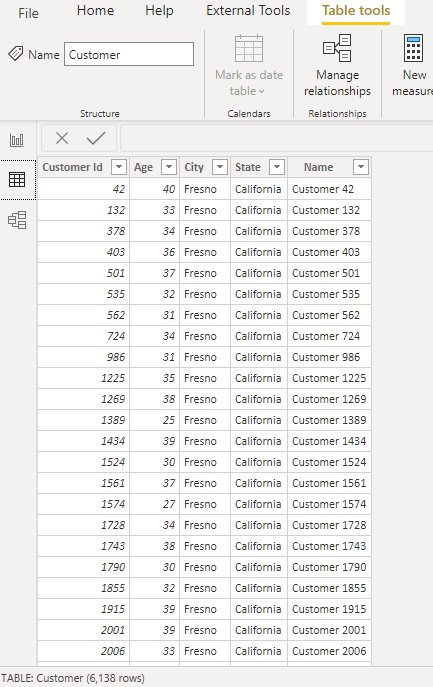
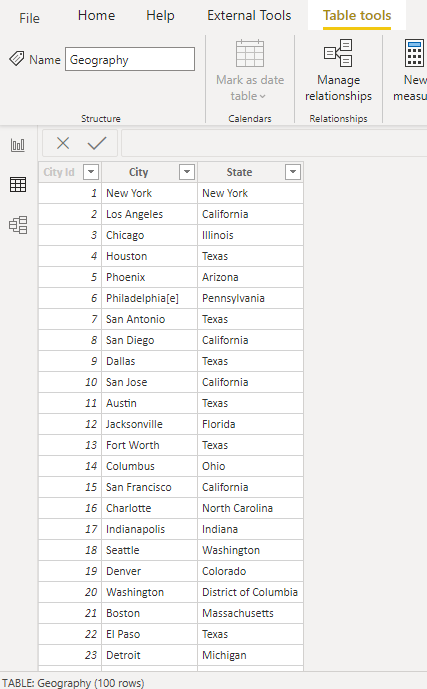


We also created a Date table in Power BI with Month, Qtr and Year information. Joined all of them.
Abbreviations:
- This Period: Rolling 3-month Sales
- Last Period: Rolling 9 Before 3 months Sales.
- New: IF This Period is NOT Blank and Last Period is Blank
- Lost: IF Last Period is NOT Blank and This Period is Blank
- Retain: IF Last Period is NOT Blank and This Period is NOT Blank
Using Time Intelligence, we will create the following:
Rolling 12 = CALCULATE([Sales],DATESINPERIOD('Date'[Date],ENDOFMONTH('Date'[Date]),-12,MONTH))
Rolling 3 = CALCULATE([Sales],DATESINPERIOD('Date'[Date],ENDOFMONTH('Date'[Date]),-3,MONTH))
Rolling 9 before three = CALCULATE([Sales],DATESINPERIOD('Date'[Date],eomonth(max('Date'[Date]),-3),-9,MONTH))
Lost Customer This Period = Sumx(VALUES(Customer[Customer Id]),if(ISBLANK([Rolling 3]) && not(ISBLANK([Rolling 9 before three])) , 1,BLANK()))
New Customer This Period = Sumx(VALUES(Customer[Customer Id]),if(ISBLANK([Rolling 9 before three]) && not(ISBLANK([Rolling 3])) , 1,BLANK()))
Retained Customer This Period = Sumx(VALUES(Customer[Customer Id]),if(not(ISBLANK([Rolling 3])) && not(ISBLANK([Rolling 9 before three])) , 1,BLANK()))


Let us know what you think about these measures. Share your thoughts on Customer Retention Part 2.
You can get all my posts at https://community.powerbi.com/t5/Data-Stories-Gallery/Blog-Analysis/m-p/1265567#M4403
The file can found at: https://community.powerbi.com/t5/Quick-Measures-Gallery/Customer-Retention-Part-2-Period-over-Period...
You must be a registered user to add a comment. If you've already registered, sign in. Otherwise, register and sign in.
- Give Users Full Control Over KPI Scale with Dynami...
- Power BI Design Skills: Why Accessibility Still St...
- How to Build Power BI Reports Using Only Prompts
- Accessibility in Action: Building Reusable Alterna...
- Stop Clicking Through Every Page to Check What Bro...
- Fabric as Code: Scale Analytics with AI and Determ...
- Power BI Dataviz World Champs Barcelona | Round 1 ...
- Fix That Meaningless Total Row in Power BI
- Standalone Power BI Copilot: From Setup to First Q...
- Power BI Dataviz World Champs | Path to Barcelona ...
-
 anilelmastasi
on:
How to Build Power BI Reports Using Only Prompts
anilelmastasi
on:
How to Build Power BI Reports Using Only Prompts
-
Gautam_Kumar01
 on:
Accessibility in Action: Building Reusable Alterna...
on:
Accessibility in Action: Building Reusable Alterna...
-
Gautam_Kumar01
on:
Stop Clicking Through Every Page to Check What Bro...
-
Gautam_Kumar01
on:
Fabric as Code: Scale Analytics with AI and Determ...
-
Gautam_Kumar01
on:
Power BI Dataviz World Champs Barcelona | Round 1 ...
- paripal on: Standalone Power BI Copilot: From Setup to First Q...
- dpandita08 on: Power BI Dataviz World Champs | Path to Barcelona ...
- ahmadulfi_ on: Power BI Dataviz World Champs Barcelona | Round 2
-
Gautam_Kumar01
on:
Tired of Resetting Your Date Slicer Every Month? P...
- Snehal2004 on: Power BI Copilot Smart Narrative: Automatic Data S...
-
How To
802 -
Tips & Tricks
788 -
Events
211 -
Support insights
121 -
Opinion
114 -
DAX
66 -
Power BI
65 -
Power Query
62 -
Power BI Dev Camp
45 -
Roundup
40 -
Power BI Desktop
40 -
Dataflow
33 -
Featured User Group Leader
30 -
Data Protection
23 -
Power BI Embedded
20 -
Time Intelligence
19 -
Tips&Tricks
18 -
PowerBI REST API
12 -
Power BI Service
8 -
Power Query Tips & Tricks
8 -
finance
8 -
Direct Query
7 -
Auto ML
6 -
financial reporting
6 -
Data Analysis
6 -
Power Automate
6 -
Data Visualization
6 -
Python
6 -
Tips and Tricks
6 -
Power BI REST API
6 -
powerbi
5 -
service
5 -
Power BI PowerShell
5 -
Machine Learning
5 -
Income Statement
5 -
Dax studio
5 -
Power BI Goals
4 -
Desktop
4 -
PowerShell
4 -
Bookmarks
4 -
Line chart
4 -
Group By
4 -
Community
4 -
RLS
4 -
M language
4 -
Life Sciences
4 -
Paginated Reports
4 -
External tool
4 -
Webinar
3 -
calendar
3 -
Gateways
3 -
R
3 -
M Query
3 -
CALCULATE
3 -
R visual
3 -
Reports
3 -
PowerApps
3 -
Data Science
3 -
Azure
3 -
Data model
3 -
Conditional Formatting
3 -
Visualisation
3 -
Administration
3 -
M code
3 -
Visuals
3 -
SQL Server 2017 Express Edition
3 -
R script
3 -
Aggregation
3 -
parameter
2 -
Industrial App Store
2 -
Week
2 -
Date duration
2 -
Formatting
2 -
Weekday Calendar
2 -
Support insights.
2 -
construct list
2 -
slicers
2 -
SAP
2 -
Power Platform
2 -
Workday
2 -
external tools
2 -
index
2 -
RANKX
2 -
Date
2 -
PBI Desktop
2 -
Date Dimension
2 -
Integer
2 -
Visualization
2 -
Power BI Challenge
2 -
Query Parameter
2 -
SharePoint
2 -
Power BI Installation and Updates
2 -
How Things Work
2 -
Tabular Editor
2 -
rank
2 -
ladataweb
2 -
Troubleshooting
2 -
Date DIFF
2 -
Transform data
2 -
Healthcare
2 -
Incremental Refresh
2 -
Number Ranges
2 -
Query Plans
2 -
Power BI & Power Apps
2 -
Random numbers
2 -
Day of the Week
2 -
Custom visual
2 -
VLOOKUP
2 -
pivot
2 -
calculated column
2 -
M
2 -
hierarchies
2 -
Power BI Anniversary
2 -
Language M
2 -
inexact
2 -
Date Comparison
2 -
Power BI Premium Per user
2 -
Forecasting
2 -
REST API
2 -
Editor
2 -
Split
2 -
measure
2 -
Microsoft-flow
2 -
Paginated Report Builder
2 -
Working with Non Standatd Periods
2 -
powerbi.tips
2 -
Custom function
2 -
Reverse
2 -
PUG
2 -
Custom Measures
2 -
Filtering
2 -
Row and column conversion
2 -
Python script
2 -
Nulls
2 -
DVW Analytics
2 -
Training
1 -
Event
1 -
Custom Visuals
1 -
Free vs Pro
1 -
Format
1 -
Active Employee
1 -
Custom Date Range on Date Slicer
1 -
refresh error
1 -
PAS
1 -
certain duration
1 -
DA-100
1 -
bulk renaming of columns
1 -
Single Date Picker
1 -
Monday
1 -
PCS
1 -
Saturday
1 -
Data Pipeline
1 -
Slicer
1 -
Visual
1 -
forecast
1 -
Regression
1 -
CICD
1 -
Current Employees
1 -
date hierarchy
1 -
relationship
1 -
SIEMENS
1 -
Multiple Currency
1 -
Power BI Premium
1 -
On-premises data gateway
1 -
Binary
1 -
Power BI Connector for SAP
1 -
Sunday
1 -
User Data Functions
1 -
Workspace
1 -
Announcement
1 -
Features
1 -
domain
1 -
pbiviz
1 -
sport statistics
1 -
Intelligent Plant
1 -
Circular dependency
1 -
GE
1 -
Exchange rate
1 -
Dendrogram
1 -
range of values
1 -
activity log
1 -
Decimal
1 -
Charticulator Challenge
1 -
Field parameters
1 -
deployment
1 -
ssrs traffic light indicators
1 -
SQL
1 -
trick
1 -
Scripts
1 -
Color Map
1 -
Industrial
1 -
Weekday
1 -
Working Date
1 -
Space Issue
1 -
Emerson
1 -
Date Table
1 -
Cluster Analysis
1 -
Stacked Area Chart
1 -
union tables
1 -
Number
1 -
Start of Week
1 -
Tips& Tricks
1 -
Theme Colours
1 -
Text
1 -
Flow
1 -
Publish to Web
1 -
Extract
1 -
Topper Color On Map
1 -
Historians
1 -
context transition
1 -
Custom textbox
1 -
OPC
1 -
Zabbix
1 -
Label: DAX
1 -
Business Analysis
1 -
Supporting Insight
1 -
rank value
1 -
Synapse
1 -
End of Week
1 -
Tips&Trick
1 -
Excel
1 -
Showcase
1 -
custom connector
1 -
Waterfall Chart
1 -
Power BI On-Premise Data Gateway
1 -
patch
1 -
Top Category Color
1 -
A&E data
1 -
Previous Order
1 -
Substring
1 -
Wonderware
1 -
Power M
1 -
Format DAX
1 -
Custom functions
1 -
accumulative
1 -
DAX&Power Query
1 -
Premium Per User
1 -
GENERATESERIES
1 -
Report Server
1 -
Audit Logs
1 -
analytics pane
1 -
step by step
1 -
Top Brand Color on Map
1 -
Tutorial
1 -
Previous Date
1 -
XMLA End point
1 -
color reference
1 -
Date Time
1 -
Marker
1 -
Lineage
1 -
CSV file
1 -
conditional accumulative
1 -
Matrix Subtotal
1 -
Check
1 -
null value
1 -
Show and Tell
1 -
Cumulative Totals
1 -
Report Theme
1 -
Bookmarking
1 -
oracle
1 -
mahak
1 -
pandas
1 -
Networkdays
1 -
Button
1 -
Dataset list
1 -
Keyboard Shortcuts
1 -
Fill Function
1 -
LOOKUPVALUE()
1 -
Tips &Tricks
1 -
Plotly package
1 -
Sameperiodlastyear
1 -
Office Theme
1 -
matrix
1 -
bar chart
1 -
Measures
1 -
powerbi argentina
1 -
Canvas Apps
1 -
total
1 -
Filter context
1 -
Difference between two dates
1 -
get data
1 -
OSI
1 -
Query format convert
1 -
ETL
1 -
Json files
1 -
Merge Rows
1 -
CONCATENATEX()
1 -
take over Datasets;
1 -
Networkdays.Intl
1 -
refresh M language Python script Support Insights
1 -
Tutorial Requests
1 -
Governance
1 -
Fun
1 -
Power BI gateway
1 -
gateway
1 -
Elementary
1 -
Custom filters
1 -
Vertipaq Analyzer
1 -
powerbi cordoba
1 -
Model Driven Apps
1 -
REMOVEFILTERS
1 -
XMLA endpoint
1 -
translations
1 -
OSI pi
1 -
Parquet
1 -
Change rows to columns
1 -
remove spaces
1 -
Get row and column totals
1 -
Retail
1 -
Power BI Report Server
1 -
School
1 -
Cost-Benefit Analysis
1 -
DIisconnected Tables
1 -
Sandbox
1 -
Honeywell
1 -
Combine queries
1 -
X axis at different granularity
1 -
ADLS
1 -
Primary Key
1 -
Microsoft 365 usage analytics data
1 -
Randomly filter
1 -
Week of the Day
1 -
Azure AAD
1 -
query
1 -
Dynamic Visuals
1 -
KPI
1 -
Intro
1 -
Icons
1 -
ISV
1 -
Ties
1 -
unpivot
1 -
Practice Model
1 -
Continuous streak
1 -
ProcessVue
1 -
Create function
1 -
Table.Schema
1 -
Acknowledging
1 -
Postman
1 -
Text.ContainsAny
1 -
Power BI Show
1 -
Get latest sign-in data for each user
1 -
Power Pivot
1 -
API
1 -
Kingsley
1 -
Merge
1 -
variable
1 -
Issues
1 -
function
1 -
stacked column chart
1 -
ho
1 -
ABB
1 -
KNN algorithm
1 -
List.Zip
1 -
optimization
1 -
Artificial Intelligence
1 -
Map Visual
1 -
Text.ContainsAll
1 -
Tuesday
1 -
Help
1 -
group
1 -
Scorecard
1 -
Json
1 -
Tops
1 -
financial reporting hierarchies RLS
1 -
Featured Data Stories
1 -
MQTT
1 -
Custom Periods
1 -
Partial group
1 -
Reduce Size
1 -
FBL3N
1 -
Wednesday
1 -
Data Engineering
1 -
Q&A
1 -
Quick Tips
1 -
data
1 -
PBIRS
1 -
Usage Metrics in Power BI
1 -
Multivalued column
1 -
Pipeline
1 -
Path
1 -
Yokogawa
1 -
Dynamic calculation
1 -
Data Wrangling
1 -
native folded query
1 -
transform table
1 -
UX
1 -
Cell content
1 -
General Ledger
1 -
Thursday
1 -
Notebook
1 -
update
1 -
Table
1 -
Natural Query Language
1 -
Infographic
1 -
automation
1 -
Prediction
1 -
newworkspacepowerbi
1 -
Performance KPIs
1 -
HR Analytics
1 -
keepfilters
1 -
Connect Data
1 -
Financial Year
1 -
Schneider
1 -
dynamically delete records
1 -
Copy Measures
1 -
Friday
1 -
Lakehouse
1
- 07-12-2026 - 07-18-2026
- 07-05-2026 - 07-11-2026
- 06-28-2026 - 07-04-2026
- 06-21-2026 - 06-27-2026
- 06-14-2026 - 06-20-2026
- 06-07-2026 - 06-13-2026
- 05-31-2026 - 06-06-2026
- 05-24-2026 - 05-30-2026
- 05-17-2026 - 05-23-2026
- 05-10-2026 - 05-16-2026
- 05-03-2026 - 05-09-2026
- 04-26-2026 - 05-02-2026
- 04-19-2026 - 04-25-2026
- View Complete Archives