
Join us at FabCon Atlanta from March 16 - 20, 2026, for the ultimate Fabric, Power BI, AI and SQL community-led event. Save $200 with code FABCOMM.
Register now!The Power BI Data Visualization World Championships is back! Get ahead of the game and start preparing now! Learn more
I need to relate to tables, one is a fact tables with rates of ressources and another one is a dimension table with details regarding each ressource.
I made sure there is no null nor duplicates in the dimension table.
let
source = #"Staff list",
#"Filtered Rows1" = Table.SelectRows(source, each [Ressource] <> null and [Ressource] <> ""),
#"Removed Duplicates" = Table.Distinct(#"Filtered Rows1", {"Ressource"})
in
#"Removed Duplicates"but PBI will still not let me join the 2 tables - it says that one of the columns must have unique values.
Any idea why it would not let join on the ressource column
Solved! Go to Solution.
OK, problem solved.
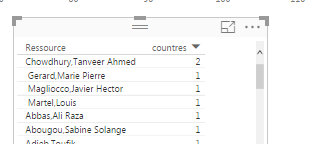
There was a space at the end of one the names. I suspected that but it was not apparent in powerquery. Anyway this should not be considered as duplicates anyway, unless there is some automatic somewhere in the process, but where...
I inverstigated it further and it turns out there are indeed 2 records of one of the resource after the RemoveDuplicates step.
How is that even possible?
OK, problem solved.
There was a space at the end of one the names. I suspected that but it was not apparent in powerquery. Anyway this should not be considered as duplicates anyway, unless there is some automatic somewhere in the process, but where...
The Power BI Data Visualization World Championships is back! Get ahead of the game and start preparing now!
Check out the November 2025 Power BI update to learn about new features.
| User | Count |
|---|---|
| 59 | |
| 43 | |
| 42 | |
| 23 | |
| 17 |
| User | Count |
|---|---|
| 190 | |
| 122 | |
| 96 | |
| 66 | |
| 47 |