Join us at FabCon Atlanta from March 16 - 20, 2026, for the ultimate Fabric, Power BI, AI and SQL community-led event. Save $200 with code FABCOMM.
Register now!The Power BI Data Visualization World Championships is back! Get ahead of the game and start preparing now! Learn more
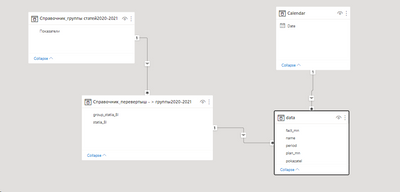
Hi! my current data model is presented above. However, I need to introduce a date column to the dimension tables and make a relationship with calendar table as well. If I do so, I will end up with many-to-many relationship of dimension tables with calendar and dimension tables with fact table. What is the best way to work with such cases?
Here you can find a sample data and board to play with.
@chulpanvl , Do not create a relationship if you just want to filter the slicer of other dimensions using dates
You can create a measure like this using a dim table and date in it and use it in the visual level filter and check for not blank
new measure =
var _max = maxx(allselected(Date),Date[Date])
var _min = minx(allselected(Date),Date[Date])
return
Countrows( filter('dim1', 'dim1'[Date] >=_min && 'dim1'[Date] <=_max))
How to filter the slicer of a disconnected table: https://youtu.be/cV5WfaQt6C8
@amitchandak thank you for your response!
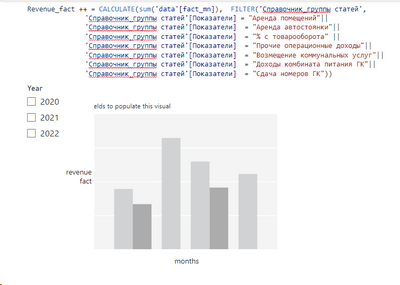
In the end I want to create a measure based on my fact table which is filtered by dimension table (see a screen) which will also take into account differences in groups of items from year to year.
I explained my case in more detail in this topic.
Check out the November 2025 Power BI update to learn about new features.
Advance your Data & AI career with 50 days of live learning, contests, hands-on challenges, study groups & certifications and more!
| User | Count |
|---|---|
| 169 | |
| 109 | |
| 91 | |
| 55 | |
| 44 |