Hi there,
I have a simplified data model with three tables.
1. account
---------

=======
2. opp( closedate dd/mm/yyyy)
----------
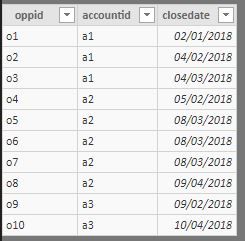
===========
3. and a date table Calendar.
=======
relationship:
account[accountid] ---> opp[accountid]
Calendar[Date] ---> opp[closedate]
======
the problematic measure:
----------
test4:=
VAR k =
ADDCOLUMNS( account,
            "date", MAXX( FILTER( opp,
                                  opp[accountid] = account[accountid]
                                  && opp[closedate] >= MIN( 'Calendar'[Date])
                                  && opp[closedate] <= MAX( 'Calendar'[Date])),
                          opp[closedate]))
RETURN
CALCULATE( COUNTROWS(k),
           FILTER( k,
                   [date]>= MIN( 'Calendar'[Date])
                   && [date] <= MAX('Calendar'[Date])))
======
expected result:
---------

however the result is:
--------
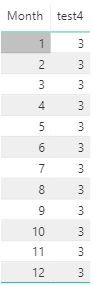
====
I can get the correct result by modifying the measure, but I would like to know what was going wrong with the problematic measure and what the different was between test4 and test2 below. Thank you.
test2:=
VAR k = ADDCOLUMNS( account,
                    "date", MAXX( FILTER( opp,
                                          opp[accountid] = account[accountid]
                                          && opp[closedate] >= MIN( 'Calendar'[Date])
                                          && opp[closedate] <= MAX( 'Calendar'[Date])),
                                  opp[closedate]))
RETURN
COUNTROWS(FILTER( k,
                  [date]>= MIN( 'Calendar'[Date])
                  && [date] <= MAX('Calendar'[Date])))


