Join us at FabCon Atlanta from March 16 - 20, 2026, for the ultimate Fabric, Power BI, AI and SQL community-led event. Save $200 with code FABCOMM.
Register now!View all the Fabric Data Days sessions on demand. View schedule
Hey All,
I deadly need your helps guys.
Let's say I have the following table:
I want firstly to distinct count the values in Col1 based on Col2 to get:
A1>>>2
B1>>>1
C1>>>1
afterthat I want to count the resultant values based on Col3:
DD>>>2
BB>>>2
if I will use directly distinct count based on Col3 the result for "BB" will be 1 which is not what I want to get at the end.
Thank you all in advance.
Regards,
Solved! Go to Solution.
Hi @AZL
How about a DISTINCTCOUNT on the concatenation of the columns you are interested in? For instance, in your first example with Col1 and Col2, you create an additional calculated column
Table1[NewColum]=Table1[Col] & Table1[Col2]
and then
DISTINCTCOUNT(Table1[NewColum])
Hi @AZL
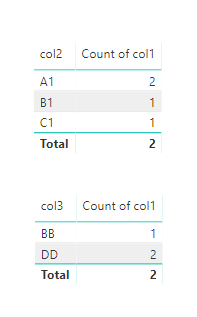
Assume you have the result as below
Per your requirement, you could create a measure
Measure = CALCULATE(DISTINCTCOUNT(Sheet3[col1]),ALLEXCEPT(Sheet3,Sheet3[col2]))
Best Regards
Maggie
Hi @AZL
How about a DISTINCTCOUNT on the concatenation of the columns you are interested in? For instance, in your first example with Col1 and Col2, you create an additional calculated column
Table1[NewColum]=Table1[Col] & Table1[Col2]
and then
DISTINCTCOUNT(Table1[NewColum])
you're very welcome. glad it helped.
Please mark it as solution then, so that it's available for others too.
Cheers
Check out the November 2025 Power BI update to learn about new features.
Advance your Data & AI career with 50 days of live learning, contests, hands-on challenges, study groups & certifications and more!