Don't miss your chance to take the Fabric Data Engineer (DP-600) exam for FREE! Find out how by attending the DP-600 session on April 23rd (pacific time), live or on-demand.
Learn moreJoin the FabCon + SQLCon recap series. Up next: Power BI, Real-Time Intelligence, IQ and AI, and Data Factory take center stage. All sessions are available on-demand after the live show. Register now
Hi,
I would like to ask for your help in finding a way to solve a recursive BOM problem in Power BI. I would like to show users all orders affected by a chosen item. However, an item produced in an order can be a component in different order, which needs to be listed as well.
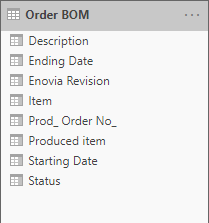
This is the table I have:
Example:
Item 123456 is directly used as component in orders o123, o456 and o789.
Item produced in o789 is used in order o01234.
Item produced in o01234 is used in order o05678.
When a user chooses item 123456 it shows them the following list:
o123
o456
o789
o01234
o05678
I used to solve problems like this by recursion in Python and this is what I was thinking about doing here but I don't have an idea how to implement it in Power BI. There is also the time aspect but I guess I would to know how to handle this.
Could you please give me any clue to solve it?
@Anonymous , refer if these can help
https://community.powerbi.com/t5/Desktop/BOM-Modeling/td-p/307652
Not really enough information to go on, please first check if your issue is a common issue listed here: https://community.powerbi.com/t5/Community-Blog/Before-You-Post-Read-This/ba-p/1116882
Also, please see this post regarding How to Get Your Question Answered Quickly: https://community.powerbi.com/t5/Community-Blog/How-to-Get-Your-Question-Answered-Quickly/ba-p/38490
The most important parts are:
1. Sample data as text, use the table tool in the editing bar
2. Expected output from sample data
3. Explanation in words of how to get from 1. to 2.
That said, DAX is very bad at recursion. https://community.powerbi.com/t5/Quick-Measures-Gallery/Previous-Value-aka-quot-Recursion-quot/m-p/6...
You can use Python and R in visuals so that may be a route to go.
Also, Power Query supports recursion, so you may be able to do something there. https://www.linkedin.com/pulse/fun-graphing-power-bi-part-3i-greg-deckler-microsoft-mvp-/
But, I don't really understand your data and exactly what you are trying to do so hard to be specific.
Check out the April 2026 Power BI update to learn about new features.
If you have recently started exploring Fabric, we'd love to hear how it's going. Your feedback can help with product improvements.
A new Power BI DataViz World Championship is coming this June! Don't miss out on submitting your entry.
| User | Count |
|---|---|
| 48 | |
| 46 | |
| 41 | |
| 20 | |
| 17 |
| User | Count |
|---|---|
| 70 | |
| 69 | |
| 32 | |
| 27 | |
| 26 |