This time we’re going bigger than ever. Fabric, Power BI, SQL, AI and more. We're covering it all. You won't want to miss it.
Learn moreLevel up your Power BI skills this month - build one visual each week and tell better stories with data! Get started
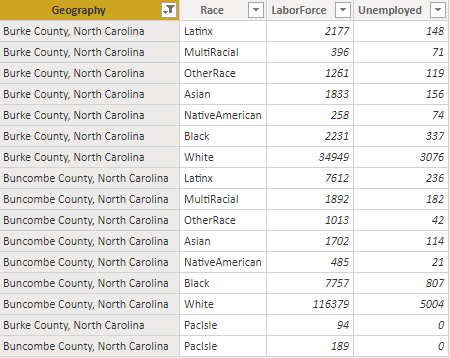
I have a single table which I created from a public dataset, with the following layout / sample records:
Now I want to create a measure for Unemployment Rate which is based on the very simple function (Unemployed / LaborForce). I need a measure instead of a calculated column, because I want to analye the data by geography and race.
UERate = DIVIDE(SUM(UE1[Unemployed]), SUM(LF1[LaborForce]))
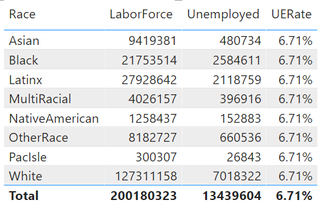
What's weird is that the measure always gives me the calculation for the entire table, regardless of how I slice the data using values from the same table, e.g.:
It's rolling up my columns correctly, but the measure is ignoring my visual filter.
What am I doing wrong?
Solved! Go to Solution.
Hi @Anonymous ,
Looking at your measure you are making the calculation based on two different tables UE1 and LF1 if the tables don't have any relationship with the table where the Race column is based then you will get the full result for both tables so in all rows the same value since there is no context connection between the measure and the table columns.
I assume that when you refer that you have a single table is a new one where you have summarize your information correct?
You need to make the measure based on that table columns in your case Race / LaborForce / Unemployed.
Regards
Miguel Félix
Proud to be a Super User!
Check out my blog: Power BI em PortuguêsWell, in the measure, you refer to two separate tables while your table shows both columns in the same table. Generally when a measure acts the way your is acting, there is a missing relationship between two tables.
Hi @Anonymous ,
Looking at your measure you are making the calculation based on two different tables UE1 and LF1 if the tables don't have any relationship with the table where the Race column is based then you will get the full result for both tables so in all rows the same value since there is no context connection between the measure and the table columns.
I assume that when you refer that you have a single table is a new one where you have summarize your information correct?
You need to make the measure based on that table columns in your case Race / LaborForce / Unemployed.
Regards
Miguel Félix
Proud to be a Super User!
Check out my blog: Power BI em PortuguêsI'm an idiot. Those were temporary tables I used as I was working through the data.
All better now - thanks.
Check out the April 2026 Power BI update to learn about new features.
Sign up to receive a private message when registration opens and key events begin.
If you have recently started exploring Fabric, we'd love to hear how it's going. Your feedback can help with product improvements.
| User | Count |
|---|---|
| 30 | |
| 24 | |
| 23 | |
| 17 | |
| 16 |
| User | Count |
|---|---|
| 61 | |
| 35 | |
| 30 | |
| 23 | |
| 22 |