Join us at FabCon Atlanta from March 16 - 20, 2026, for the ultimate Fabric, Power BI, AI and SQL community-led event. Save $200 with code FABCOMM.
Register now!The Power BI Data Visualization World Championships is back! Get ahead of the game and start preparing now! Learn more
I am trying to show the effects of inflation on values. In this case, the values are billing rates. I have a measure that calculates the average billing rate as follows:
Average Hourly Rate = SUM(Timeslips[Hourly Value])/SUM(Timeslips[Hours])
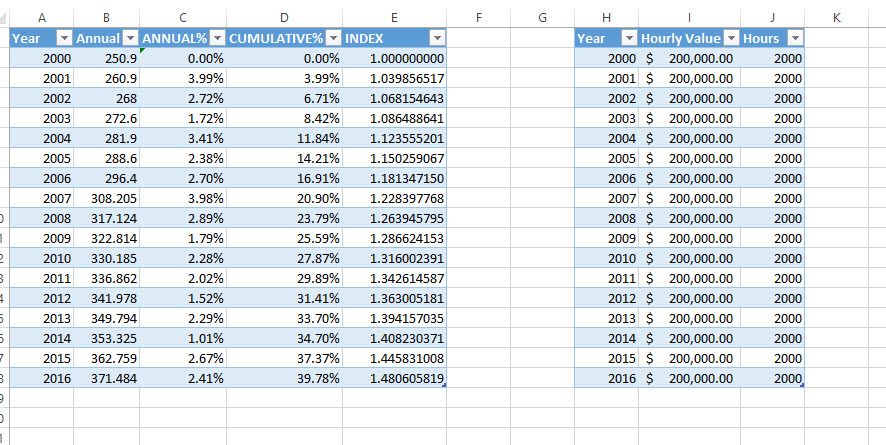
I also have a table of inflation data from the Bureau of Labor Statistics for the years 2000 to 2016 (Base Period 1982-84=100):
Year Annual ANNUAL% CUMULATIVE% INDEX 2000 250.9 0.00% 0.00% 1 2001 260.9 3.99% 3.99% 1.039856517 2002 268.0 2.72% 6.71% 1.068154643 2003 272.6 1.72% 8.42% 1.086488641 2004 281.9 3.41% 11.84% 1.123555201 2005 288.6 2.38% 14.21% 1.150259067 2006 296.4 2.70% 16.91% 1.18134715 2007 308.205 3.98% 20.90% 1.228397768 2008 317.124 2.89% 23.79% 1.263945795 2009 322.814 1.79% 25.59% 1.286624153 2010 330.185 2.28% 27.87% 1.316002391 2011 336.862 2.02% 29.89% 1.342614587 2012 341.978 1.52% 31.41% 1.363005181 2013 349.794 2.29% 33.70% 1.394157035 2014 353.325 1.01% 34.70% 1.408230371 2015 362.759 2.67% 37.37% 1.445831008 2016 371.484 2.41% 39.78% 1.480605819
Both the Timeslips table and the BLS Data Table have a relationship to a Date table in my data model.
So, I would like to factor the annual average billing rates by the inflation data to show constant dollars. E.g., a billing rate of $100 per hour in 2000 would be equal to a 2016 billing rate of 100/1.480605819=67.53 per hour.
While the math is simple, I am stumped on how to develop a measure to show this. Any help would be appreciated.
Solved! Go to Solution.
@MojoGene I might need an example of your hourly data to better understand what you're trying to get at, but I set up the below along with an overly simplified aggregate dataset. I didn't bother making a date table since my table was aggregated, but the concepts should be the same - not sure until I see it. Anyway, I just made an additional measure based on your measure:
Average Rate Infl Adj = [Average Hourly Rate] / AVERAGE(BLSData[INDEX])
If you give me a little more demo info I'll try to get a better answer.
Dan
@MojoGene I might need an example of your hourly data to better understand what you're trying to get at, but I set up the below along with an overly simplified aggregate dataset. I didn't bother making a date table since my table was aggregated, but the concepts should be the same - not sure until I see it. Anyway, I just made an additional measure based on your measure:
Average Rate Infl Adj = [Average Hourly Rate] / AVERAGE(BLSData[INDEX])
If you give me a little more demo info I'll try to get a better answer.
Dan
Dan:
Thanks very much for the input. Your solution works as I intended. I was actually encountering problems because PBI Desktop was bringing in the BLS data as text and the date relationship was not being picked up correctly. It took me a while to get that straightened out, but once I did I was able to follow your explanation very clearly.
Thanks.
The Power BI Data Visualization World Championships is back! Get ahead of the game and start preparing now!
Check out the November 2025 Power BI update to learn about new features.
| User | Count |
|---|---|
| 59 | |
| 43 | |
| 42 | |
| 23 | |
| 17 |
| User | Count |
|---|---|
| 190 | |
| 122 | |
| 96 | |
| 66 | |
| 47 |