Join us at FabCon Atlanta from March 16 - 20, 2026, for the ultimate Fabric, Power BI, AI and SQL community-led event. Save $200 with code FABCOMM.
Register now!The Power BI Data Visualization World Championships is back! Get ahead of the game and start preparing now! Learn more
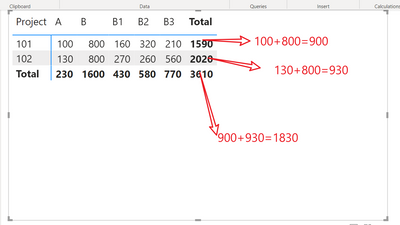
In my sample data B1,B2, B3 is child level of B, so we don't sum them in the total. However I need to show them in the detail. Please give me some idea
| Project | Code | Amount |
| 101 | A | 100 |
| 101 | B | 800 |
| 101 | B1 | 160 |
| 101 | B2 | 320 |
| 101 | B3 | 210 |
| 102 | A | 130 |
| 102 | B | 800 |
| 102 | B1 | 270 |
| 102 | B2 | 260 |
| 102 | B3 | 560 |
Final Result:
Solved! Go to Solution.
Hi, please try this
measure
SUM =
var select_code = SELECTEDVALUE (Code column)
return if (select_code <> blank(),SUM(Amount),CALCULATE(SUM(Amount), Code column in {"A","B"}))
Hi, please try this
measure
SUM =
var select_code = SELECTEDVALUE (Code column)
return if (select_code <> blank(),SUM(Amount),CALCULATE(SUM(Amount), Code column in {"A","B"}))
Thanks a lot, It works for me
The Power BI Data Visualization World Championships is back! Get ahead of the game and start preparing now!
| User | Count |
|---|---|
| 151 | |
| 130 | |
| 109 | |
| 79 | |
| 54 |