Join us at FabCon Atlanta from March 16 - 20, 2026, for the ultimate Fabric, Power BI, AI and SQL community-led event. Save $200 with code FABCOMM.
Register now!The Power BI Data Visualization World Championships is back! Get ahead of the game and start preparing now! Learn more
Hi all,
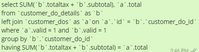
What method should I be using if I were to achieve the same results as below?
SQL query:
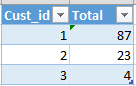
It is similar to this:
Customer Table
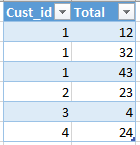
Customer_details Table:
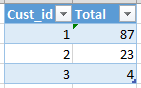
Expected Results (measure):
I would like to show only matched cust_id from two separate tables and sum the total up! Hopefully someone can guide me through this.
Thank you!
Solved! Go to Solution.
@Anonymous,
You may use DAX below to add a measure to Customer table.
Measure =
VAR Cust_id =
MAX ( Customer[Cust_id] )
RETURN
SUMX (
FILTER ( Customer_details, Customer_details[Cust_id] = Cust_id ),
Customer_details[Total]
)
@Anonymous,
You may use DAX below to add a measure to Customer table.
Measure =
VAR Cust_id =
MAX ( Customer[Cust_id] )
RETURN
SUMX (
FILTER ( Customer_details, Customer_details[Cust_id] = Cust_id ),
Customer_details[Total]
)
The Power BI Data Visualization World Championships is back! Get ahead of the game and start preparing now!
| User | Count |
|---|---|
| 37 | |
| 37 | |
| 33 | |
| 32 | |
| 29 |
| User | Count |
|---|---|
| 130 | |
| 88 | |
| 82 | |
| 68 | |
| 64 |