cancel
Showing results for 
Search instead for 
Did you mean: 

Level up your Power BI skills this month - build one visual each week and tell better stories with data! Get started

Reply
Iamnvt
Continued Contributor

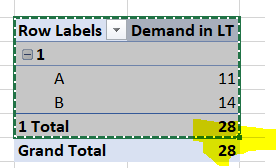
Incorrect total

hi, I know this is a classic problem that can be resolved with SUMX, but somehow, I couldn't get it done.


Here is the file:

https://1drv.ms/x/s!Aps8poidQa5zk5NCkQV_1tDZcbThRQ


I can't match the total as below:

Capture.PNG


thank in advance

1 ACCEPTED SOLUTION

@Iamnvt


In a single step, you can do like this


But i think better to create a second measure like in the earlier post


Demand in LT =
IF (
    HASONEFILTER ( LT[Mat] ),
    SUMX (
        VALUES ( LT[Mat] ),
        VAR newLT =
            SUMX ( LT, LT[LT] )
        VAR filtertable =
            FILTER (
                ALL ( 'Calendar' ),
                'Calendar'[Date] >= TODAY ()
                    && 'Calendar'[Date] - TODAY ()
                        <= newLT
            )
        RETURN
            CALCULATE ( SUM ( Demand[Demand] ), filtertable )
    ),
    SUMX (
        VALUES ( LT[Mat] ),
        CALCULATE (
            SUMX (
                VALUES ( LT[Mat] ),
                VAR newLT =
                    SUMX ( LT, LT[LT] )
                VAR filtertable =
                    FILTER (
                        ALL ( 'Calendar' ),
                        'Calendar'[Date] >= TODAY ()
                            && 'Calendar'[Date] - TODAY ()
                                <= newLT
                    )
                RETURN
                    CALCULATE ( SUM ( Demand[Demand] ), filtertable )
            )
        )
    )
)

View solution in original post

3 REPLIES 3
Zubair_Muhammad
Community Champion
Community Champion

@Iamnvt


You can use this MEASURE


Measure =
IF (
    HASONEFILTER ( LT[Mat] ),
    [Demand in LT],
    SUMX ( VALUES ( LT[Mat] ), [Demand in LT] )
)

@Zubair_Muhammad

thanks for the solution.

How can I combine the two measures: [Demand in LT], and [Measure 1] into 1 measure only?


I tried to put the same formula of [Demand in LT] into [Measure 1], but it didn't give the correct result.


Thanks

@Iamnvt


In a single step, you can do like this


But i think better to create a second measure like in the earlier post


Demand in LT =
IF (
    HASONEFILTER ( LT[Mat] ),
    SUMX (
        VALUES ( LT[Mat] ),
        VAR newLT =
            SUMX ( LT, LT[LT] )
        VAR filtertable =
            FILTER (
                ALL ( 'Calendar' ),
                'Calendar'[Date] >= TODAY ()
                    && 'Calendar'[Date] - TODAY ()
                        <= newLT
            )
        RETURN
            CALCULATE ( SUM ( Demand[Demand] ), filtertable )
    ),
    SUMX (
        VALUES ( LT[Mat] ),
        CALCULATE (
            SUMX (
                VALUES ( LT[Mat] ),
                VAR newLT =
                    SUMX ( LT, LT[LT] )
                VAR filtertable =
                    FILTER (
                        ALL ( 'Calendar' ),
                        'Calendar'[Date] >= TODAY ()
                            && 'Calendar'[Date] - TODAY ()
                                <= newLT
                    )
                RETURN
                    CALCULATE ( SUM ( Demand[Demand] ), filtertable )
            )
        )
    )
)

Helpful resources

Announcements
April Power BI Update Carousel

Power BI Monthly Update - April 2026

Check out the April 2026 Power BI update to learn about new features.

Fabric SQL PBI Data Days

Data Days 2026 coming soon!

Sign up to receive a private message when registration opens and key events begin.

New to Fabric survey Carousel

New to Fabric Survey

If you have recently started exploring Fabric, we'd love to hear how it's going. Your feedback can help with product improvements.

Power BI DataViz World Championships carousel

Power BI DataViz World Championships - June 2026

A new Power BI DataViz World Championship is coming this June! Don't miss out on submitting your entry.