Join us at FabCon Atlanta from March 16 - 20, 2026, for the ultimate Fabric, Power BI, AI and SQL community-led event. Save $200 with code FABCOMM.
Register now!Get Fabric Certified for FREE during Fabric Data Days. Don't miss your chance! Request now
Request assistance in following :
Following is the table that I have imported in Desktop- Table1:
Category | Date | Data |
Category1 | 1/1/2017 | 10 |
Category1 | 1/2/2017 | 11 |
Category1 | 1/3/2017 | 12 |
Category1 | 1/4/2017 | 13 |
Category2 | 1/1/2017 | 14 |
Category2 | 1/2/2017 | 15 |
Category2 | 1/3/2017 | 16 |
Category2 | 1/4/2017 | 17 |
Category3 | 1/1/2017 | 18 |
Category3 | 1/2/2017 | 19 |
Category3 | 1/3/2017 | 20 |
Category3 | 1/4/2017 | 21 |
Report:
In the report, I want to display values based on following date slicer
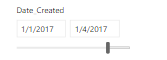
Date Slicer:
Only the values corresponding to the first date on the slicer and the last date on the slicer should be displayed in the report:
| 1/1/2017 | 1/4/2017 | %change |
Category1 | 10 | 13 | (13-10)/10 |
Category2 | 14 | 17 | (17-14)/14 |
Category3 | 18 | 21 | (21-18)/18 |
Hi @Aniket.
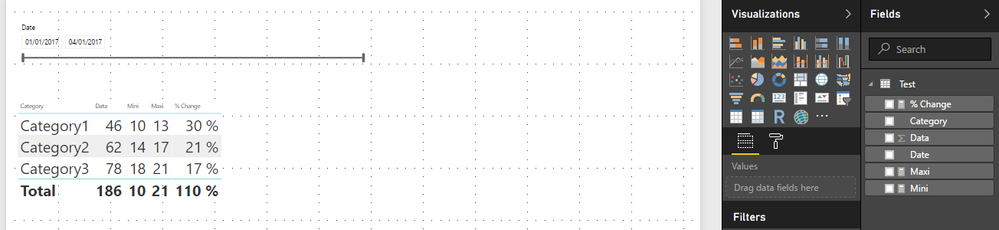
I created 3 measures based on your data ( I called the table Test) :
-Mini = CALCULATE(MIN(Test[Data]))
-Maxi = CALCULATE(MAX(Test[Data]))
-% Change = DIVIDE([Maxi]-[Mini],[Mini],BLANK())
Below is the image.
Ninter
Hello @Interkoubess Ninter,
The dates I require are not min and max from the table, but it should be min and max from the date slicer.
Check out the November 2025 Power BI update to learn about new features.
Advance your Data & AI career with 50 days of live learning, contests, hands-on challenges, study groups & certifications and more!