Join us at FabCon Atlanta from March 16 - 20, 2026, for the ultimate Fabric, Power BI, AI and SQL community-led event. Save $200 with code FABCOMM.
Register now!The Power BI Data Visualization World Championships is back! Get ahead of the game and start preparing now! Learn more
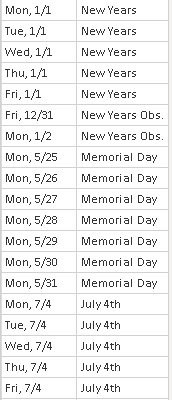
I've been agonizing over holidays and how to find them in the master calendar but I wanted to avoid the idea of keeping a static list of holidays. The neat thing about a holiday is that it has to occur on 1 of 7 days without regard for the year (even leap years). So I create a small table of 42 rows - 7 for each holiday. Now I can create a field in my calendar formatted with ddd, m/d - set a relation and and use the related function to pull the holiday.
Interesting. So Thanksgiving would be like so yes?
| dddmd | Holiday |
| Thu, 11/22 | Thanksgiving |
| Thu, 11/23 | Thanksgiving |
| Thu, 11/24 | Thanksgiving |
| Thu, 11/25 | Thanksgiving |
| Thu, 11/26 | Thanksgiving |
| Thu, 11/27 | Thanksgiving |
| Thu, 11/28 | Thanksgiving |
| Fri, 11/23 | Thanksgiving Turkey Coma |
| Fri, 11/24 | Thanksgiving Turkey Coma |
| Fri, 11/25 | Thanksgiving Turkey Coma |
| Fri, 11/26 | Thanksgiving Turkey Coma |
| Fri, 11/27 | Thanksgiving Turkey Coma |
| Fri, 11/28 | Thanksgiving Turkey Coma |
| Fri, 11/29 | Thanksgiving Turkey Coma |
Pretty much. Does it save time over a standard holiday lookup? maybe but we can easily have a hybrid solution. Some holidays do not have a pattern or (e.g. easter) the pattern is very complex. For a calendar of 100 years with 13 holidays = 1300 row. date patterns would need only 91 rows and its a simple lookup instead of remembering (or forgetting) to extend the holiday list.
The Power BI Data Visualization World Championships is back! Get ahead of the game and start preparing now!
| User | Count |
|---|---|
| 39 | |
| 37 | |
| 33 | |
| 32 | |
| 29 |
| User | Count |
|---|---|
| 133 | |
| 88 | |
| 85 | |
| 68 | |
| 64 |