Join us at FabCon Atlanta from March 16 - 20, 2026, for the ultimate Fabric, Power BI, AI and SQL community-led event. Save $200 with code FABCOMM.
Register now!The Power BI Data Visualization World Championships is back! Get ahead of the game and start preparing now! Learn more
I have a table of purchases.
Each row is a purchase with an unique ID and a ClientID.
Each client can have multiple purchases.
I want to group based on how much each client spent.
Lets say I want 5 groups:
0-100€
100-200€
200-500€
500-1000€
> 1000 €
Any help on the correct approach?
Solved! Go to Solution.
Hi @PDRTXRA ,
According to your description, here's my solution.
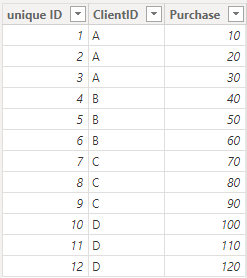
Sample:
Create a measure:
Measure =
VAR _SUM =
SUM ( 'Table'[Purchase] )
RETURN
SWITCH (
TRUE,
_SUM > 0
&& _SUM <= 100, "0-100€",
_SUM > 100
&& _SUM <= 200, "100-200€",
_SUM > 200
&& _SUM <= 500, "200-500€",
_SUM > 500
&& _SUM <= 1000, "500-1000€",
_SUM > 1000, ">1000€"
)
Get the correct result:
I attach my sample below for your reference.
Best regards,
Community Support Team_yanjiang
If this post helps, then please consider Accept it as the solution to help the other members find it more quickly.
Hi @PDRTXRA ,
According to your description, here's my solution.
Sample:
Create a measure:
Measure =
VAR _SUM =
SUM ( 'Table'[Purchase] )
RETURN
SWITCH (
TRUE,
_SUM > 0
&& _SUM <= 100, "0-100€",
_SUM > 100
&& _SUM <= 200, "100-200€",
_SUM > 200
&& _SUM <= 500, "200-500€",
_SUM > 500
&& _SUM <= 1000, "500-1000€",
_SUM > 1000, ">1000€"
)
Get the correct result:
I attach my sample below for your reference.
Best regards,
Community Support Team_yanjiang
If this post helps, then please consider Accept it as the solution to help the other members find it more quickly.
The Power BI Data Visualization World Championships is back! Get ahead of the game and start preparing now!
| User | Count |
|---|---|
| 38 | |
| 36 | |
| 33 | |
| 33 | |
| 29 |
| User | Count |
|---|---|
| 134 | |
| 96 | |
| 78 | |
| 67 | |
| 65 |