FabCon is coming to Atlanta
Join us at FabCon Atlanta from March 16 - 20, 2026, for the ultimate Fabric, Power BI, AI and SQL community-led event. Save $200 with code FABCOMM.
Register now!- Power BI forums
- Get Help with Power BI
- Desktop
- Service
- Report Server
- Power Query
- Mobile Apps
- Developer
- DAX Commands and Tips
- Custom Visuals Development Discussion
- Health and Life Sciences
- Power BI Spanish forums
- Translated Spanish Desktop
- Training and Consulting
- Instructor Led Training
- Dashboard in a Day for Women, by Women
- Galleries
- Data Stories Gallery
- Themes Gallery
- Contests Gallery
- QuickViz Gallery
- Quick Measures Gallery
- Visual Calculations Gallery
- Notebook Gallery
- Translytical Task Flow Gallery
- TMDL Gallery
- R Script Showcase
- Webinars and Video Gallery
- Ideas
- Custom Visuals Ideas (read-only)
- Issues
- Issues
- Events
- Upcoming Events
The Power BI Data Visualization World Championships is back! Get ahead of the game and start preparing now! Learn more
- Power BI forums
- Forums
- Get Help with Power BI
- Desktop
- Getting range of week numbers from earlier year's ...
- Subscribe to RSS Feed
- Mark Topic as New
- Mark Topic as Read
- Float this Topic for Current User
- Bookmark
- Subscribe
- Printer Friendly Page

- Mark as New
- Bookmark
- Subscribe
- Mute
- Subscribe to RSS Feed
- Permalink
- Report Inappropriate Content
Getting range of week numbers from earlier year's week
| Quarter | Count | Week | Year |
| Q1 | 23 | 2 | FY20 |
| Q2 | 21 | 2 | FY20 |
| Q3 | 44 | 31 | FY19 |
| Q4 | 21 | 23 | FY19 |
| Q4 | 11 | 1 | FY19 |
| Q4 | 34 | 2 | FY19 |
Example above:
My FY20, Q1 , Week 2 requires values from FY19, Q4, Week 1 & 2 (Weeks to date)
This works
CALCULATE(
COUNT(TABLE1[Name]),
FILTER(all(Fisc_Cal), Fisc_Cal[Fiscal_Qtr] = 4 &&
Corp_Fisc_Cal[Fiscal_Year] = max( Fisc_Cal[Fiscal_Year])-1 && Fisc_Cal[Qtr_Wk] < 3)),
but instead of <3, i need to dynamically count the earlier weeks fromt the currently selected week. Nothing seems to work.
Help !!!
Solved! Go to Solution.


- Mark as New
- Bookmark
- Subscribe
- Mute
- Subscribe to RSS Feed
- Permalink
- Report Inappropriate Content
Hi @jogenpatel ,
To update your measure as below.
QoQ% =
--min(Corp_Fisc_Cal[Fiscal_Qtr])
VAR cQtr =
    MIN ( Corp_Fisc_Cal[Fiscal_Qtr] )
VAR cQwk =
    MIN ( Corp_Fisc_Cal[Qtr_Wk] )
VAR cYr =
    MIN ( Corp_Fisc_Cal[Fiscal_Year] )
VAR _year =
    YEAR ( TODAY () ) + 1
RETURN
    VAR total_LQtr =
        IF (
            cQtr = 1
                && cYr = _year,
            CALCULATE (
                DISTINCTCOUNT ( vw_Bolt_Helpdesk_PBI[Name] ),
                FILTER (
                    ALL ( Corp_Fisc_Cal ),
                    Corp_Fisc_Cal[Fiscal_Qtr] = 1
                        && Corp_Fisc_Cal[Fiscal_Year]
                            = MAX ( Corp_Fisc_Cal[Fiscal_Year] ) - 1
                )
            ),
            IF (
                cQtr = 1,
                CALCULATE (
                    DISTINCTCOUNT ( vw_Bolt_Helpdesk_PBI[Name] ),
                    FILTER (
                        ALL ( Corp_Fisc_Cal ),
                        Corp_Fisc_Cal[Fiscal_Qtr] = 4
                            && Corp_Fisc_Cal[Fiscal_Year]
                                = MAX ( Corp_Fisc_Cal[Fiscal_Year] ) - 1
                    )
                ),
                CALCULATE (
                    DISTINCTCOUNT ( vw_Bolt_Helpdesk_PBI[Name] ),
                    FILTER (
                        ALL ( Corp_Fisc_Cal ),
                        Corp_Fisc_Cal[Fiscal_Qtr]
                            = MAX ( Corp_Fisc_Cal[Fiscal_Qtr] ) - 1
                            && Corp_Fisc_Cal[Fiscal_Year] = MAX ( Corp_Fisc_Cal[Fiscal_Year] )
                    )
                )
            )
        )
    RETURN
        total_LQtr
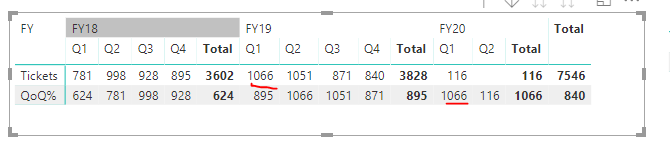
Please find the pbix as attached.
Regards,
Frank
If this post helps, then please consider Accept it as the solution to help the others find it more quickly.
- Mark as New
- Bookmark
- Subscribe
- Mute
- Subscribe to RSS Feed
- Permalink
- Report Inappropriate Content
Hi @jogenpatel ,
To create a calculated table as below.
week = GENERATESERIES(1,100,1)
Add the value column of the week table in a slicer.Then we can update your formula as below.
CALCULATE(
COUNT(TABLE1[Name]),
FILTER(all(Fisc_Cal), Fisc_Cal[Fiscal_Qtr] = 4 &&
Corp_Fisc_Cal[Fiscal_Year] = max( Fisc_Cal[Fiscal_Year])-1 && Fisc_Cal[Qtr_Wk] < SELECTEDVALUE(week[Value])))
If it doesn't meet your requirement, kindly share your sample data and excepted result to me. Please upload your files to One Drive and share the link here.
Regards,
Frank
If this post helps, then please consider Accept it as the solution to help the others find it more quickly.
- Mark as New
- Bookmark
- Subscribe
- Mute
- Subscribe to RSS Feed
- Permalink
- Report Inappropriate Content
Hi @v-frfei-msft (Frank),
Thank you for replying.
We do not need to add the week to the slicer as that calculation will apply only for the current Qtr. I've explained my scenario below.
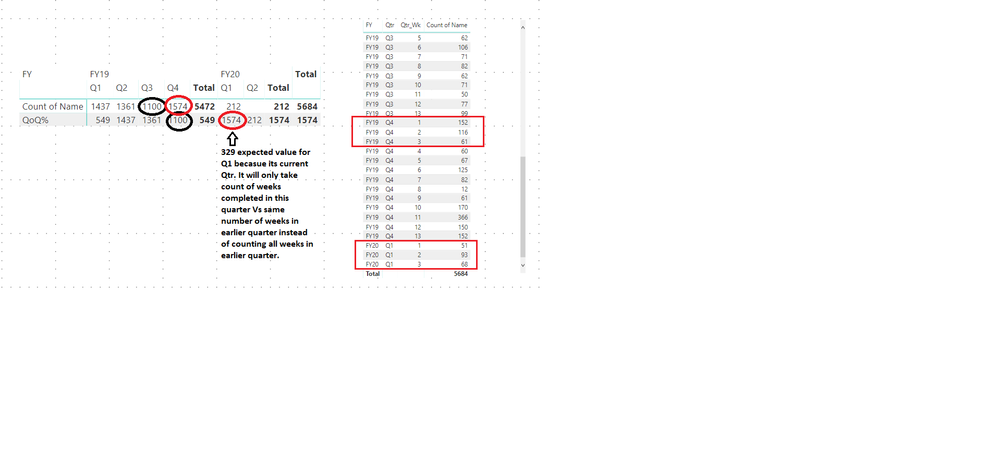
The QoQ calculation takes the total of the earlier quarter and computes with the following quarter. However, if the Quarter is current, it will take the counts of the completed weeks of that current quarter Vs the same number of weeks from the earlier quarter instead of taking the total count from the earlier week. I've attached the sample PBI below:
Here is the link to the Sample pbix:
https://1drv.ms/u/s!ApqSgyl2itergSJlAjXGQMyhUEPa
thank you again!!
- Mark as New
- Bookmark
- Subscribe
- Mute
- Subscribe to RSS Feed
- Permalink
- Report Inappropriate Content
Hi @jogenpatel ,
To update your measure as below.
QoQ% =
--min(Corp_Fisc_Cal[Fiscal_Qtr])
VAR cQtr =
    MIN ( Corp_Fisc_Cal[Fiscal_Qtr] )
VAR cQwk =
    MIN ( Corp_Fisc_Cal[Qtr_Wk] )
VAR cYr =
    MIN ( Corp_Fisc_Cal[Fiscal_Year] )
VAR _year =
    YEAR ( TODAY () ) + 1
RETURN
    VAR total_LQtr =
        IF (
            cQtr = 1
                && cYr = _year,
            CALCULATE (
                DISTINCTCOUNT ( vw_Bolt_Helpdesk_PBI[Name] ),
                FILTER (
                    ALL ( Corp_Fisc_Cal ),
                    Corp_Fisc_Cal[Fiscal_Qtr] = 1
                        && Corp_Fisc_Cal[Fiscal_Year]
                            = MAX ( Corp_Fisc_Cal[Fiscal_Year] ) - 1
                )
            ),
            IF (
                cQtr = 1,
                CALCULATE (
                    DISTINCTCOUNT ( vw_Bolt_Helpdesk_PBI[Name] ),
                    FILTER (
                        ALL ( Corp_Fisc_Cal ),
                        Corp_Fisc_Cal[Fiscal_Qtr] = 4
                            && Corp_Fisc_Cal[Fiscal_Year]
                                = MAX ( Corp_Fisc_Cal[Fiscal_Year] ) - 1
                    )
                ),
                CALCULATE (
                    DISTINCTCOUNT ( vw_Bolt_Helpdesk_PBI[Name] ),
                    FILTER (
                        ALL ( Corp_Fisc_Cal ),
                        Corp_Fisc_Cal[Fiscal_Qtr]
                            = MAX ( Corp_Fisc_Cal[Fiscal_Qtr] ) - 1
                            && Corp_Fisc_Cal[Fiscal_Year] = MAX ( Corp_Fisc_Cal[Fiscal_Year] )
                    )
                )
            )
        )
    RETURN
        total_LQtr
Please find the pbix as attached.
Regards,
Frank
If this post helps, then please consider Accept it as the solution to help the others find it more quickly.
- Mark as New
- Bookmark
- Subscribe
- Mute
- Subscribe to RSS Feed
- Permalink
- Report Inappropriate Content

Helpful resources

Power BI Dataviz World Championships
The Power BI Data Visualization World Championships is back! Get ahead of the game and start preparing now!

Power BI Monthly Update - December 2025
Check out the December 2025 Power BI Holiday Recap!

FabCon Atlanta 2026
Join us at FabCon Atlanta, March 16-20, for the ultimate Fabric, Power BI, AI and SQL community-led event. Save $200 with code FABCOMM.

| User | Count |
|---|---|
| 40 | |
| 38 | |
| 36 | |
| 29 | |
| 28 |


| User | Count |
|---|---|
| 127 | |
| 88 | |
| 78 | |
| 66 | |
| 65 |

