Join us at FabCon Atlanta from March 16 - 20, 2026, for the ultimate Fabric, Power BI, AI and SQL community-led event. Save $200 with code FABCOMM.
Register now!Vote for your favorite vizzies from the Power BI Dataviz World Championship submissions. Vote now!
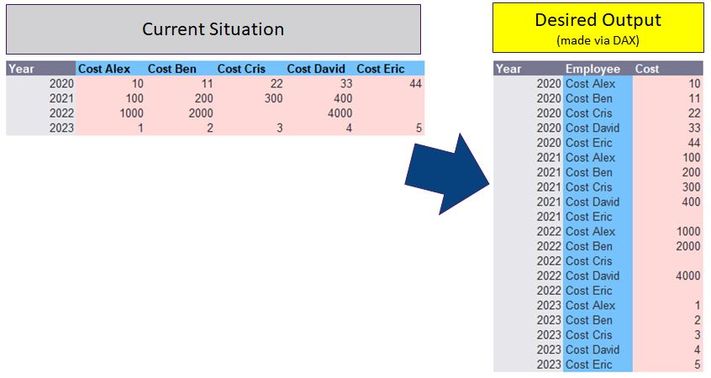
Hey, I have the following problem shown in the picture.
I need to solve it with DAX language.
Are formulas useful here like
A) Generateseries
B) Addcolumns( Summarize ( ) )
How do I create this new table?
Solved! Go to Solution.
Hi @Anonymous ,
Here are the steps you can follow:
1. Create calculated table.
Table 2 =
UNION(
SELECTCOLUMNS('Table',"Year",'Table'[Year],"Employee","Cost Alex","Cost",'Table'[Cost Alex]),
SELECTCOLUMNS('Table',"Year",'Table'[Year],"Employee","Cost Ben","Cost",'Table'[Cost Ben]),
SELECTCOLUMNS('Table',"Year",'Table'[Year],"Employee","Cost Cris","Cost",'Table'[Cost Cris]),
SELECTCOLUMNS('Table',"Year",'Table'[Year],"Employee","Cost David","Cost",'Table'[Cost David]),
SELECTCOLUMNS('Table',"Year",'Table'[Year],"Employee","Cost Eric","Cost",'Table'[Cost Eric]))
2. Click [Year] to set as Sort ascending.

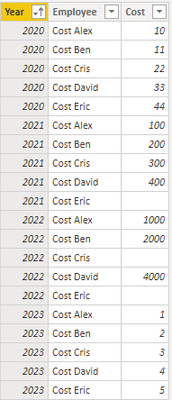
3. Result:
Best Regards,
Liu Yang
If this post helps, then please consider Accept it as the solution to help the other members find it more quickly
Hi @Anonymous ,
Here are the steps you can follow:
1. Create calculated table.
Table 2 =
UNION(
SELECTCOLUMNS('Table',"Year",'Table'[Year],"Employee","Cost Alex","Cost",'Table'[Cost Alex]),
SELECTCOLUMNS('Table',"Year",'Table'[Year],"Employee","Cost Ben","Cost",'Table'[Cost Ben]),
SELECTCOLUMNS('Table',"Year",'Table'[Year],"Employee","Cost Cris","Cost",'Table'[Cost Cris]),
SELECTCOLUMNS('Table',"Year",'Table'[Year],"Employee","Cost David","Cost",'Table'[Cost David]),
SELECTCOLUMNS('Table',"Year",'Table'[Year],"Employee","Cost Eric","Cost",'Table'[Cost Eric]))
2. Click [Year] to set as Sort ascending.
3. Result:
Best Regards,
Liu Yang
If this post helps, then please consider Accept it as the solution to help the other members find it more quickly
Hi @FrankAT
unfortunatelly PowerQuery is not an option, as the initial table is already an extra table which was created with DAX.
I am looking for an DAX solution.
Hi @Anonymous ,
the easiest, shortes an best way to get the desired result is to use Power Query. Unpivot the Cost columns.
With kind regards from the town where the legend of the 'Pied Piper of Hamelin' is at home
FrankAT (Proud to be a Datanaut)
Vote for your favorite vizzies from the Power BI World Championship submissions!
If you love stickers, then you will definitely want to check out our Community Sticker Challenge!
Check out the January 2026 Power BI update to learn about new features.
| User | Count |
|---|---|
| 57 | |
| 55 | |
| 42 | |
| 16 | |
| 16 |
| User | Count |
|---|---|
| 113 | |
| 106 | |
| 38 | |
| 35 | |
| 26 |