Get Fabric or SQL Certified for Free.
Get certified for free when you join Fabric Data Days 2026 and dive into Fabric, Power BI, SQL, AI, and other essential data skills.
Join now- Power BI forums
- Get Help with Power BI
- Desktop
- Service
- Report Server
- Power Query
- Mobile Apps
- Developer
- DAX Commands and Tips
- Custom Visuals Development Discussion
- Health and Life Sciences
- Power BI Spanish forums
- Translated Spanish Desktop
- Training and Consulting
- Instructor Led Training
- Dashboard in a Day for Women, by Women
- Galleries
- Data Stories Gallery
- Themes Gallery
- Contests Gallery
- QuickViz Gallery
- Quick Measures Gallery
- Visual Calculations Gallery
- Notebook Gallery
- Translytical Task Flow Gallery
- TMDL Gallery
- R Script Showcase
- Webinars and Video Gallery
- Ideas
- Custom Visuals Ideas (read-only)
- Issues
- Issues
- Events
- Upcoming Events
Try your skills in the Power BI Dataviz World Championship! Round one ends June 26. Join now
- Power BI forums
- Forums
- Get Help with Power BI
- Desktop
- Dynamic Calculated column in matrix
- Subscribe to RSS Feed
- Mark Topic as New
- Mark Topic as Read
- Float this Topic for Current User
- Bookmark
- Subscribe
- Printer Friendly Page

- Mark as New
- Bookmark
- Subscribe
- Mute
- Subscribe to RSS Feed
- Permalink
- Report Inappropriate Content
Dynamic Calculated column in matrix
Hi ,
How to create dynamic calulated(Total) Column in matrix by using the names.
For example i have two names like ABC , DEF and in future the new name will add say GHI with values.
Now i need to calculate a column with the values dynamically.
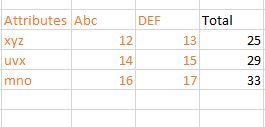
why am asking to calculate the column is i need to move the total column from right to left.
Sorry for my poor Explanation .
And thank in Advance.
Regards,
Suresh Pantra.


- Mark as New
- Bookmark
- Subscribe
- Mute
- Subscribe to RSS Feed
- Permalink
- Report Inappropriate Content
Hi @Anonymous
I think the best option would be to unpivot the data so that all your labels (ABC, DEF, GHI etc) become values in a single column with the corresponding numerical values in another column.
To do this, in the query editor select any columns that you want to be fixed (in your example the 'Attributes' Column) - note that there is no need for a total column - and select 'Unpivot Other Columns'. You can rename this column e.g. to 'ColAttributes'
In the report view, create a measure which just sums your numerical values column and then in the matrix have your Attributes columns on rows, your ColAttributes column on columns and ensure you have the option for column sub-totals selected
- Mark as New
- Bookmark
- Subscribe
- Mute
- Subscribe to RSS Feed
- Permalink
- Report Inappropriate Content
Hi rsaprano,
Thank you for your reply.
It is an unpivoted data. Can you please explain in detail.
Regards,
Suresh pantra.
- Mark as New
- Bookmark
- Subscribe
- Mute
- Subscribe to RSS Feed
- Permalink
- Report Inappropriate Content
Hi @Anonymous ,
Here is a link to a PBIX that has your sample data in there with the unpivot example applied in the query editor as i was suggesting (along with the matrix)...if you edit source and add a new column to the table it will be picked up automatically.
Here is an animated gif that shows how to apply the steps.
If this answers your query, please mark the answer as accepted!
Thanks
Rishi


- Mark as New
- Bookmark
- Subscribe
- Mute
- Subscribe to RSS Feed
- Permalink
- Report Inappropriate Content
Provide a sample data that can be copied here and show your expected output.
Thank you
- Mark as New
- Bookmark
- Subscribe
- Mute
- Subscribe to RSS Feed
- Permalink
- Report Inappropriate Content
Hi mussaenda,
PFA
| Category | Attribute | ABC | DEF | GHI | Total |
| Motor_vehicals | Accessories | 23 | 32 | 54 | 109 |
| Bikes | 34 | 23 | 32 | 89 | |
| Cars | 54 | 23 | 23 | 100 | |
| Trucks | 45 | 12 | 13 | 70 |
expecting the total column which i need to use next to the attribute Column.In future for example if JKL data has came it has to calculate that data also into the total.
Regards,
Suresh Pantra.


- Mark as New
- Bookmark
- Subscribe
- Mute
- Subscribe to RSS Feed
- Permalink
- Report Inappropriate Content
Hello @Anonymous
Can you please share a sample of your data so we can copy an paste (not a picture)? That will help us answer the question.
- Mark as New
- Bookmark
- Subscribe
- Mute
- Subscribe to RSS Feed
- Permalink
- Report Inappropriate Content
Hi jdbuchanan,
PFA
| Category | Attribute | ABC | DEF | GHI | Total |
| Motor_vehicals | Accessories | 23 | 32 | 54 | 109 |
| Bikes | 34 | 23 | 32 | 89 | |
| Cars | 54 | 23 | 23 | 100 | |
| Trucks | 45 | 12 | 13 | 70 |
expecting the total column which i need to use next to the attribute Column.In future for example if JKL data has came it has to calculate that data also into the total.
Regards,
Suresh Pantra.
- Mark as New
- Bookmark
- Subscribe
- Mute
- Subscribe to RSS Feed
- Permalink
- Report Inappropriate Content
@Anonymous
The columns ABC, DEF, GHI are seperate columns in your data table? If so you can write a measure to add them together, you would just have to add in new columns as the appear in the table:
Total = SUM ( YourTable[ABC] ) + SUM ( YourTable[DEF] ) + SUM ( YourTable[GHI] )
- Mark as New
- Bookmark
- Subscribe
- Mute
- Subscribe to RSS Feed
- Permalink
- Report Inappropriate Content
@jdbuchanan71 - this measure wouldn't automatically pick up a new column (e.g JKL) which is the requirement!
- Mark as New
- Bookmark
- Subscribe
- Mute
- Subscribe to RSS Feed
- Permalink
- Report Inappropriate Content
In order for the new entries to get picked up you will have to unpivot them to a name value pair in the query editor. Select all the columns that are not one of the value columns (ABC, DEF, GHI) and choose unpivot other columns. That way when new columns come in they will get picked up by the unpivot.
Helpful resources

Data Days 2026
Don't miss out on Data Days, June 15 through August 7. Learn Fabric, Power BI, SQL, AI and more.

Power BI DataViz World Championships - June 2026
A new Power BI DataViz World Championship is coming this June! Don't miss out on submitting your entry.

| User | Count |
|---|---|
| 23 | |
| 21 | |
| 20 | |
| 20 | |
| 11 |


| User | Count |
|---|---|
| 62 | |
| 55 | |
| 47 | |
| 45 | |
| 35 |


