Friends, I have tried in all ways to use the Distinct or the DistinctCount within that Groupby, but due to limitations it does not work at all. How would it be possible to do this in the "CodAtendimento" field that is marked in the image?
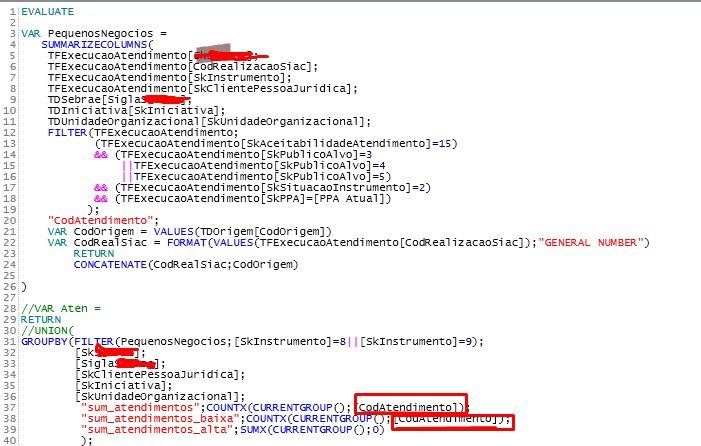
EVALUATE

VAR PequenosNegocios =
   SUMMARIZECOLUMNS(
 TFExecucaoAtendimento[SkTeste];
 TFExecucaoAtendimento[CodRealizacaoSiac];
 TFExecucaoAtendimento[SkInstrumento];
 TFExecucaoAtendimento[SkClientePessoaJuridica];
 TDSebrae[SiglaTeste];
 TDIniciativa[SkIniciativa];
 TDUnidadeOrganizacional[SkUnidadeOrganizacional];
 FILTER(TFExecucaoAtendimento;
     (TFExecucaoAtendimento[SkAceitabilidadeAtendimento]=15)
     && (TFExecucaoAtendimento[SkPublicoAlvo]=3
         ||TFExecucaoAtendimento[SkPublicoAlvo]=4
         ||TFExecucaoAtendimento[SkPublicoAlvo]=5)
     && (TFExecucaoAtendimento[SkSituacaoInstrumento]=2)
     && (TFExecucaoAtendimento[SkPPA]=[PPA Atual])
    );
 "CodAtendimento";
 VAR CodOrigem = VALUES(TDOrigem[CodOrigem])
 VAR CodRealSiac = FORMAT(VALUES(TFExecucaoAtendimento[CodRealizacaoSiac]);"GENERAL NUMBER")
  RETURN
  CONCATENATE(CodRealSiac;CodOrigem)

)

//VAR Aten =
RETURN
//UNION(
GROUPBY(FILTER(PequenosNegocios;[SkInstrumento]=8||[SkInstrumento]=9);
  [SkTeste];
        [SiglaTeste];
       [SkClientePessoaJuridica];
   [SkIniciativa];
    [SkUnidadeOrganizacional];
   "sum_atendimentos";COUNTX(CURRENTGROUP();[CodAtendimento]);
   "sum_atendimentos_baixa";COUNTX(CURRENTGROUP();[CodAtendimento]);
   "sum_atendimentos_alta";SUMX(CURRENTGROUP();0)
   )


