Join us at FabCon Atlanta from March 16 - 20, 2026, for the ultimate Fabric, Power BI, AI and SQL community-led event. Save $200 with code FABCOMM.
Register now!The Power BI Data Visualization World Championships is back! Get ahead of the game and start preparing now! Learn more
I have this table:
ID | ClientID | Date(dd/mm/yyyy)| Amount
-----------------------------------------------
6 | 1 | 01/01/2021 | 100
8 | 1 | 01/01/2021 | 150
3 | 1 | 02/01/2021 | 50
1 | 1 | 09/01/2021 | 200
5 | 2 | 03/01/2021 | 100
4 | 2 | 06/01/2021 | 50
7 | 2 | 07/01/2021 | 100
3 | 2 | 07/01/2021 | 50
9 | 2 | 07/01/2021 | 200
I need a running total base on the ClientID and the date but if there is a duplicate date I want to Sum the smaller ID.
Expected result:
ID | ClientID | Date(dd/mm/yyyy)| Amount |Running Sum
-------------------------------------------------
6 | 1 | 01/01/2021 | 100 | 100
8 | 1 | 01/01/2021 | 150 | 250
3 | 1 | 02/01/2021 | 50 | 300
1 | 1 | 09/01/2021 | 200 | 500
5 | 2 | 03/01/2021 | 100 | 100
4 | 2 | 06/01/2021 | 50 | 150
7 | 2 | 07/01/2021 | 100 | 300
3 | 2 | 07/01/2021 | 50 | 200
9 | 2 | 07/01/2021 | 200 | 500
I tried somthing like that without any luck:
RunningTotal =
var ClientIDValue = TBL[ClientID]
var DateValue = TBL[Date]
var FilterTbl = FILTER(TBL,TBL[ClientID] = ClientIDValue && TBL[Date] <= DateValue)
RETURN
CALCULATE(
sum(TBL[Amount])
,FilteredTbl
)
Solved! Go to Solution.
Hi @xl0911 ,
On the query editor sort you data by:
Then add and index column now do your column in the following way:
CUMULATIVE =
CALCULATE (
SUM ( 'Table'[ Amount] ),
FILTER (
ALL ( 'Table' ),
'Table'[ ClientID ] = EARLIER ( 'Table'[ ClientID ] )
&& 'Table'[ Date(dd/mm/yyyy)] <= EARLIER ( 'Table'[ Date(dd/mm/yyyy)] )
&& 'Table'[Index] >= EARLIER ( 'Table'[Index] )
)
)
Regards
Miguel Félix
Proud to be a Super User!
Check out my blog: Power BI em PortuguêsHi @xl0911 ,
On the query editor sort you data by:
Then add and index column now do your column in the following way:
CUMULATIVE =
CALCULATE (
SUM ( 'Table'[ Amount] ),
FILTER (
ALL ( 'Table' ),
'Table'[ ClientID ] = EARLIER ( 'Table'[ ClientID ] )
&& 'Table'[ Date(dd/mm/yyyy)] <= EARLIER ( 'Table'[ Date(dd/mm/yyyy)] )
&& 'Table'[Index] >= EARLIER ( 'Table'[Index] )
)
)
Regards
Miguel Félix
Proud to be a Super User!
Check out my blog: Power BI em PortuguêsIs it possible to do it without the query editor, only with pure DAX ?
Hi @xl0911 ,
Since your value is based on dates and ID try the following:
Ranking = RANKX('Table', FORMAT('Table'[ Date(dd/mm/yyyy)], "###")*10000 + 'Table'[ID ], ,ASC)
Be aware that depeding on the total value of your ID you may need to multiply by more that 10000 in order that your calculation gets the correct maximum values.
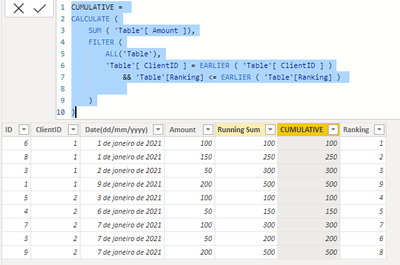
CUMULATIVE =
CALCULATE (
SUM ( 'Table'[ Amount ]),
FILTER (
ALL('Table'),
'Table'[ ClientID ] = EARLIER ( 'Table'[ ClientID ] )
&& 'Table'[Ranking] <= EARLIER ( 'Table'[Ranking] )
)
)
Result below:
Has you can see the column CUMULATIVE is equal to the Running Sum that I added from your table to show comparision.
Regards
Miguel Félix
Proud to be a Super User!
Check out my blog: Power BI em PortuguêsThe Power BI Data Visualization World Championships is back! Get ahead of the game and start preparing now!
Check out the November 2025 Power BI update to learn about new features.
| User | Count |
|---|---|
| 59 | |
| 43 | |
| 42 | |
| 23 | |
| 17 |
| User | Count |
|---|---|
| 190 | |
| 122 | |
| 96 | |
| 66 | |
| 47 |