Dear All,
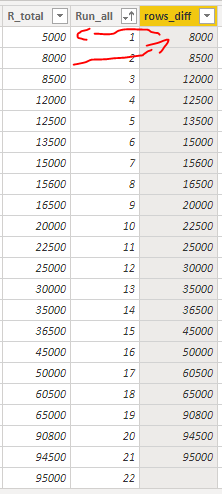
I am trying to calculate row diff between two consecutive rows of Running Total % (which is Measure) based on two consecutive Rank All Machine (which is also Measure). Rank all Machine is being calculated based on the Sum of duration.
There are also four slicers named Machine, Machine Type, year & week available in the report and Component, Sum of Duration, Machine, Machine Type, Year & week are part of Table named Downtime.
Row Diff of Running Total % should be calculated based on two consecutive Ranks(Rank 3 row - Rank 2 row & Rank 6 row - Rank 5 row)
I have tried below dax but it is not working and tr returns an empty value.
Row diff =
VAR NEXT =[Rank All Machine] +1
return
CALCULATE([Running Total %],FILTER(Downtime,Downtime[Running Total %]=NEXT))
@Phil_Seamark @Anonymous Can you please help me with this request.
| Component (Table column) | Sum of Duration (Table Column) | Running Total %(Measure) | Rank All Machine(Measure) | Row Diff(Need New Measures) | | | |
| Component 9 | 4.85 | 40,10 | 1 | 0,00 | | | |
| component 3 | 2.10 | 57,40 | 2 | 17,30 | | slicer 1-Machine |
| component 2 | 1.37 | 68,70 | 3 | 11,30 | | | |
| Component 4 | 1.35 | 79,90 | 4 | 11,20 | | slicer 2- Machine type |
| component 6 | 0.70 | 85,60 | 5 | 5,70 | | | |
| component 5 | 0.63 | 90,80 | 6 | 5,20 | | slicer 3- Year |
| Component 8 | 0.49 | 94,90 | 7 | 4,10 | | | |
| component 12 | 0.45 | 98,70 | 8 | 3,80 | | slicer 4- week |
| Component 7 | 0.12 | 99,70 | 9 | 1,00 | | | |
| Component 10 | 0.02 | 99,80 | 10 | 0,10 | | | |