Join us at FabCon Atlanta from March 16 - 20, 2026, for the ultimate Fabric, Power BI, AI and SQL community-led event. Save $200 with code FABCOMM.
Register now!The Power BI Data Visualization World Championships is back! It's time to submit your entry. Live now!
Hello all,
So I have a list of projects in a separate PowerBI Table, let's say Table 1, as the one below
| Project ID | Amount | Tax |
| 1 | ||
| 2 | ||
| 3 | ||
| 4 | ||
| 5 |
At the same time, I have a bigger table, called table 2, where data is uploaded every month and it can go for as long as 12 months. See the example below.
| Date | Project ID | Amount | Tax |
| September | 1 | 234 | 23 |
| September | 2 | 343 | 34 |
| September | 3 | 3 | 1 |
| September | 4 | 67 | 2 |
| September | 5 | 65 | 0 |
| September | 6 | 45 | 3 |
| September | 7 | 2 | 6 |
| October | 2 | 234 | 21 |
| October | 3 | 322 | 3 |
| October | 4 | 34 | 4 |
| October | 5 | 23 | 5 |
| October | 6 | 43 | 6 |
| October | 7 | 23 | 6 |
What I would like to do, is to fill in the information in Table 1, with values from the most recent month when data is available. In my case, that would be data from October. In table 2 I have a date column, so I should be able to use data formulas. Also, most of the time, the most recent month is the previous month, if that helps. So if We are now in September, the most recent month when a project from table 1 will apear in table 2, was August. I tried different Max and filter formulas but could not make it work.
Thanks for helping me!
Solved! Go to Solution.
@Anonymous , Try new column in table 1
new column =
var _Date = maxx(filter(Table2,Table1[project] =Table2[project] ),Table2[Date])
return
sumx(filter(Table2,Table1[project] =Table2[project] && eomonth(Table2[Date],0) = eomonth(_Date,0)),Table2[Amount])
@Anonymous
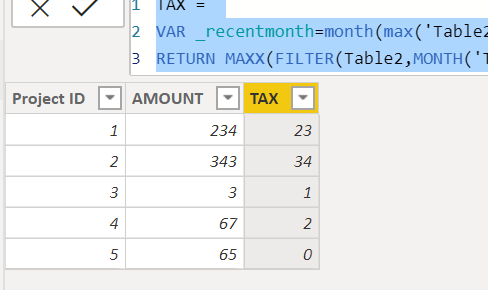
Please try to create two columns
AMOUNT =
VAR _recentmonth=month(max('Table2'[Date]))-1
RETURN MAXX(FILTER(Table2,MONTH('Table2'[Date])=_recentmonth&&Table1[Project ID]=Table2[Project ID]),Table2[Amount])
TAX =
VAR _recentmonth=month(max('Table2'[Date]))-1
RETURN MAXX(FILTER(Table2,MONTH('Table2'[Date])=_recentmonth&&Table1[Project ID]=Table2[Project ID]),Table2[Tax])
Proud to be a Super User!
@Anonymous , Try new column in table 1
new column =
var _Date = maxx(filter(Table2,Table1[project] =Table2[project] ),Table2[Date])
return
sumx(filter(Table2,Table1[project] =Table2[project] && eomonth(Table2[Date],0) = eomonth(_Date,0)),Table2[Amount])
Worked perfectly. Thanks!
The Power BI Data Visualization World Championships is back! It's time to submit your entry.
| User | Count |
|---|---|
| 49 | |
| 43 | |
| 36 | |
| 33 | |
| 30 |
| User | Count |
|---|---|
| 138 | |
| 118 | |
| 59 | |
| 59 | |
| 56 |