FabCon is coming to Atlanta
Join us at FabCon Atlanta from March 16 - 20, 2026, for the ultimate Fabric, Power BI, AI and SQL community-led event. Save $200 with code FABCOMM.
Register now!- Power BI forums
- Get Help with Power BI
- Desktop
- Service
- Report Server
- Power Query
- Mobile Apps
- Developer
- DAX Commands and Tips
- Custom Visuals Development Discussion
- Health and Life Sciences
- Power BI Spanish forums
- Translated Spanish Desktop
- Training and Consulting
- Instructor Led Training
- Dashboard in a Day for Women, by Women
- Galleries
- Data Stories Gallery
- Themes Gallery
- Contests Gallery
- QuickViz Gallery
- Quick Measures Gallery
- Visual Calculations Gallery
- Notebook Gallery
- Translytical Task Flow Gallery
- TMDL Gallery
- R Script Showcase
- Webinars and Video Gallery
- Ideas
- Custom Visuals Ideas (read-only)
- Issues
- Issues
- Events
- Upcoming Events
The Power BI Data Visualization World Championships is back! Get ahead of the game and start preparing now! Learn more
- Power BI forums
- Forums
- Get Help with Power BI
- Desktop
- Average days in Inventory. FIFO
- Subscribe to RSS Feed
- Mark Topic as New
- Mark Topic as Read
- Float this Topic for Current User
- Bookmark
- Subscribe
- Printer Friendly Page

- Mark as New
- Bookmark
- Subscribe
- Mute
- Subscribe to RSS Feed
- Permalink
- Report Inappropriate Content
Average days in Inventory. FIFO
Hello,
I have a table of a all items in inventory each with their purchase dates, items sales, purchase cost and inventory stock at hand. I am trying to calculate the average days in inventory of these items using FIFO. In other words I need the formula to work something like this:
Average days in inventory=((no of items purchased in purchase N - sales item FIFO) * number of days in inventory)/inventory at hand
Thanks
- Mark as New
- Bookmark
- Subscribe
- Mute
- Subscribe to RSS Feed
- Permalink
- Report Inappropriate Content
Hi @amitchandak , @v-juanli-msft , @Ashish_Mathur
Here's a link with a sample dataset of what I'm trying to do.
https://drive.google.com/open?id=1yFP0WlZkJE2USgeRYWuHevMGZ7q0sJn4maEY4c2OYC4
Column E has the Average days of Inventory formula I'm trying to create.
Thanks,


- Mark as New
- Bookmark
- Subscribe
- Mute
- Subscribe to RSS Feed
- Permalink
- Report Inappropriate Content
As tested, the cell E3 should be 1 based on your formula.
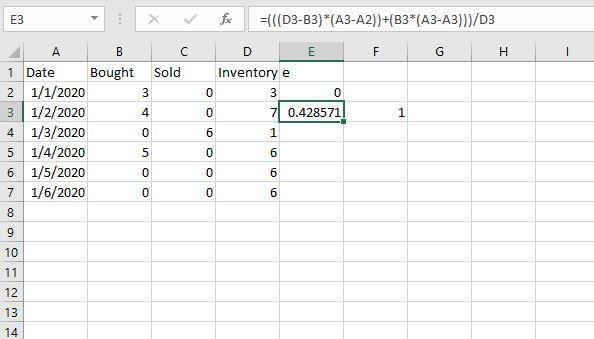
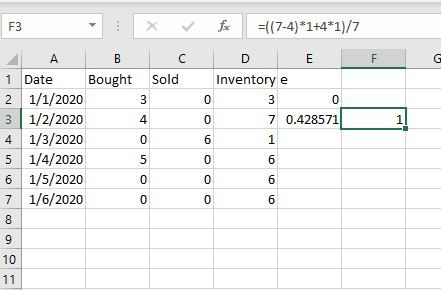
Also every cells in Column E has different formulas.
I don't understand the calculation rule.
Is your formula like something here?
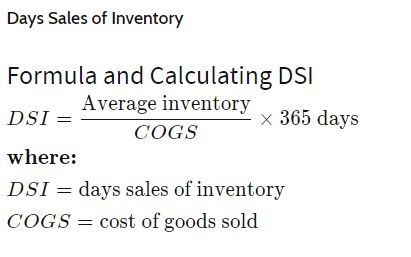
\begin{aligned} &DSI = \frac{\text{Average inventory}}{COGS} \times 365 \text{ days}\\ &\textbf{where:}\\ &DSI=\text{days sales of inventory}\\ &COGS=\text{cost of goods sold}\\ \end{alignedBest Regards
Maggie
Community Support Team _ Maggie Li
If this post helps, then please consider Accept it as the solution to help the other members find it more quickly.
- Mark as New
- Bookmark
- Subscribe
- Mute
- Subscribe to RSS Feed
- Permalink
- Report Inappropriate Content
Hello @v-juanli-msft
Every cell has a different formula because I want to determine the age of the inventory taking into account the order in which the product(s) entered. Is the same thing as if I buy a product in different dates and the selling price of the product is different. On sheet2 of the following link I've created an example doing what I want to do but instead of using dates I used price. In column F you can see the formulas I used. Just like the previous example there's in not a constant formula because it depends on the date the product was bought.
https://drive.google.com/open?id=1yFP0WlZkJE2USgeRYWuHevMGZ7q0sJn4maEY4c2OYC4
Thanks,
- Mark as New
- Bookmark
- Subscribe
- Mute
- Subscribe to RSS Feed
- Permalink
- Report Inappropriate Content
Sorry, i still can't solve this problem.
I search some documents how to use DAX to calculate Inventory or Stock Valuation using FIFO.
Best Regards
Maggie


- Mark as New
- Bookmark
- Subscribe
- Mute
- Subscribe to RSS Feed
- Permalink
- Report Inappropriate Content
@lisamariegp7 ,Can you share sample data and sample output.
I am hosting a webinar on 25th April on Power BI, Check Details - https://www.linkedin.com/posts/amitchandak78_webinar-tech-techforgood-activity-6658266754378231808-y...
- Mark as New
- Bookmark
- Subscribe
- Mute
- Subscribe to RSS Feed
- Permalink
- Report Inappropriate Content
Could you show some data example?
Please use some example to show "purchase N, sales item FIFO, inventory at hand" so i can make a test.
Best Regards
Maggie

- Mark as New
- Bookmark
- Subscribe
- Mute
- Subscribe to RSS Feed
- Permalink
- Report Inappropriate Content
Hi,
Share a dataset and show the expected result.
Regards,
Ashish Mathur
http://www.ashishmathur.com
https://www.linkedin.com/in/excelenthusiasts/

Helpful resources

Power BI Dataviz World Championships
The Power BI Data Visualization World Championships is back! Get ahead of the game and start preparing now!

Power BI Monthly Update - December 2025
Check out the December 2025 Power BI Holiday Recap!

FabCon Atlanta 2026
Join us at FabCon Atlanta, March 16-20, for the ultimate Fabric, Power BI, AI and SQL community-led event. Save $200 with code FABCOMM.

| User | Count |
|---|---|
| 39 | |
| 37 | |
| 33 | |
| 32 | |
| 29 |


| User | Count |
|---|---|
| 133 | |
| 88 | |
| 85 | |
| 68 | |
| 64 |


