
Join us at FabCon Atlanta from March 16 - 20, 2026, for the ultimate Fabric, Power BI, AI and SQL community-led event. Save $200 with code FABCOMM.
Register now!The Power BI Data Visualization World Championships is back! Get ahead of the game and start preparing now! Learn more
Hi,
I need your help please !
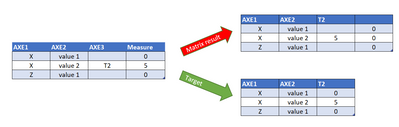
Here is a diagram explaining my problem and the expected result.
Thank you for your help !
Solved! Go to Solution.
Hi @mahsy ,
Maybe the formula is not standardized enough, try this one:
Measure =
CALCULATE (
SUM ( 'Table'[Value] ),
FILTER (
ALLSELECTED ( 'Table' ),
'Table'[AXE1] = MAX ( 'Table'[AXE1] )
&& 'Table'[AXE2] = MAX ( 'Table'[AXE2] )
)
)
This can get the result by your sample.
I attach my sample below for reference.
Best Regards,
Community Support Team _ kalyj
If this post helps, then please consider Accept it as the solution to help the other members find it more quickly.
@mahsy , Try a measure like
calculate(sum(Table[Value]), filter(allselected(Table), Table[AXE1] = max(Table[AXE1] ) && Table[AXE2] = max(Table[AXE2] ) ) )
Hi, thank you for your response !
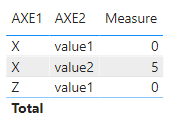
I get this error with your formula.
Hi @mahsy ,
Maybe the formula is not standardized enough, try this one:
Measure =
CALCULATE (
SUM ( 'Table'[Value] ),
FILTER (
ALLSELECTED ( 'Table' ),
'Table'[AXE1] = MAX ( 'Table'[AXE1] )
&& 'Table'[AXE2] = MAX ( 'Table'[AXE2] )
)
)
This can get the result by your sample.
I attach my sample below for reference.
Best Regards,
Community Support Team _ kalyj
If this post helps, then please consider Accept it as the solution to help the other members find it more quickly.
The Power BI Data Visualization World Championships is back! Get ahead of the game and start preparing now!
| User | Count |
|---|---|
| 19 | |
| 13 | |
| 10 | |
| 4 | |
| 4 |
| User | Count |
|---|---|
| 31 | |
| 28 | |
| 19 | |
| 11 | |
| 10 |