Get certified for free when you join Fabric Data Days 2026 and dive into Fabric, Power BI, SQL, AI, and other essential data skills.
Join nowData Days is here! Join us now for 60+ days of learning, challenges, and connection. Learn more
I am tracking a list of users' total sales for incentive purposes. Incentives are paid on a monthly & quarterly basis, using a point system to determine the incentive. Points are assigned as follows:
0-2 sales : 1 point
3-5 sales : 2 points
5+ sales : 3 points
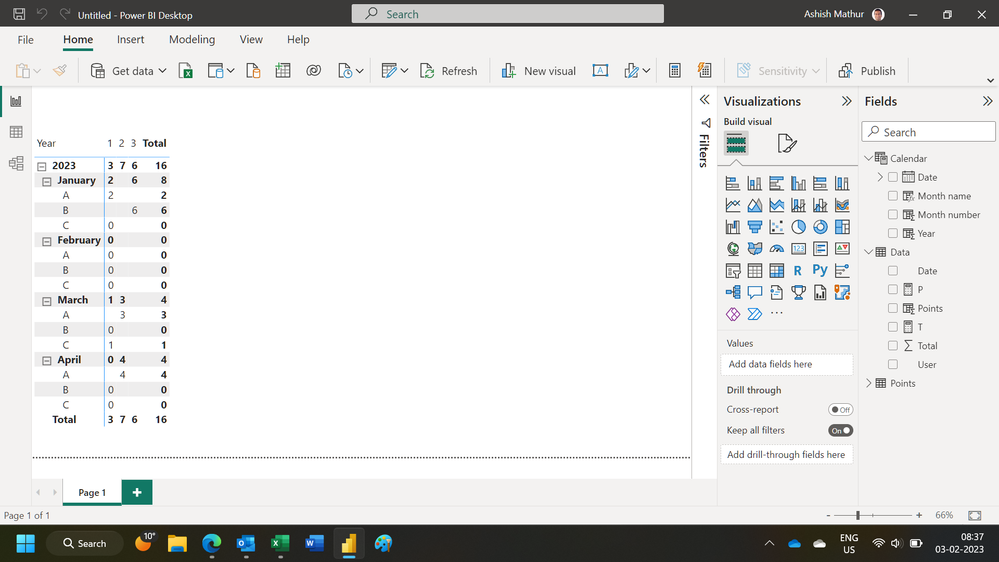
For some reason I am struggling to figure out how to calculate the total number of points by month & by quarter for each user, including the quarter-to-date totals. Here is an example:
| User | Total | |
| Jan-23 | A | 2 |
| Feb-23 | A | 0 |
| Mar-23 | A | 3 |
| Apr-23 | A | 4 |
| Jan-23 | B | 6 |
| Feb-23 | B | 0 |
| Mar-23 | B | 0 |
| Apr-23 | B | 0 |
| Jan-23 | C | 0 |
| Feb-23 | C | 0 |
| Mar-23 | C | 1 |
| Apr-23 | C | 0 |
Any idea how I can produce these results?
| User | Total | Points | |
| Jan-23 | A | 2 | 1 |
| Feb-23 | A | 0 | 1 |
| Mar-23 | A | 3 | 2 |
| Apr-23 | A | 4 | 2 |
| Jan-23 | B | 6 | 3 |
| Feb-23 | B | 0 | 1 |
| Mar-23 | B | 0 | 1 |
| Apr-23 | B | 0 | 1 |
| Jan-23 | C | 0 | 1 |
| Feb-23 | C | 0 | 1 |
| Mar-23 | C | 1 | 1 |
| Apr-23 | C | 0 | 1 |
| User | 1Q points | 2Q points (to date) |
| A | 2 | 2 |
| B | 3 | 1 |
| C | 1 | 1 |
In my case, the quarterly amount is not a sum of the points, it is based on the sum of the total sales. For example, User A had 5 total sales in Q1, so it should be 2 points. This is where I am struggling the most. I can get the monthly totals working, but I can't figure out how to do it quarterly (and show it in the same matrix if possible). Any ideas?
Hi @Anonymous ,
Here are the steps you can follow:
1. Create calculated column.
Month-Year =
FORMAT(
'Table'[Date],"mmm")
&"-"&
FORMAT('Table'[Date],"yy")
2. Create measure.
Value =
SUMX(
FILTER(ALL('Table'),
'Table'[Month-Year]=MAX('Table'[Month-Year])&&'Table'[User]=MAX('Table'[User])),[Total])Point =
SWITCH(
TRUE(),
[Value]>=0&&[Value]<=2,1,
[Value]>=3&&[Value]<=5,2,3)1Q points =
SUMX(
FILTER(ALL('Table'),
'Table'[User]=MAX('Table'[User])
&&
YEAR('Table'[Date])=YEAR(MAX('Table'[Date]))&&
QUARTER('Table'[Date])=1
),[Point])2Q points =
SUMX(
FILTER(ALL('Table'),
'Table'[User]=MAX('Table'[User])
&&
YEAR('Table'[Date])=YEAR(MAX('Table'[Date]))&&
QUARTER('Table'[Date])=2
),[Point])
3. Result:
Best Regards,
Liu Yang
If this post helps, then please consider Accept it as the solution to help the other members find it more quickly
Hi,
You may download my PBI file from here.
hope this helps.
@Anonymous The first one should be something like:
Points Measure =
VAR __Sum = SUM('Table'[Total])
VAR __Result =
SWITCH(TRUE(),
__Sum < 3, 1,
__Sum < 6, 2,
3
)
RETURN
__Result
Don't miss out on Data Days, June 15 through August 7. Learn Fabric, Power BI, SQL, AI and more.
Check out the May 2026 Power BI update to learn about new features.
| User | Count |
|---|---|
| 23 | |
| 23 | |
| 21 | |
| 17 | |
| 13 |
| User | Count |
|---|---|
| 58 | |
| 51 | |
| 39 | |
| 29 | |
| 24 |