cancel
Showing results for 
Search instead for 
Did you mean: 

We've captured the moments from FabCon & SQLCon that everyone is talking about, and we are bringing them to the community, live and on-demand. Starts on April 14th. Register now

Reply
colin_dickson
Frequent Visitor

Month by month variance from previous month

Hi,


I'm fairly new to Power BI.


I have a simple matrix table which has types of service on the rows, months as columns and the some of each as the values, as follows:


ServiceJanFebMar
Service 1

500

800

300
Service 2600900400
Service 37001,000500


What I want to be able to to do is convert that so I can see the variance from the previous month i.e. Service 1 from Jan to Feb would be a positive variance of 300 and so on.


I've tried all sorts but nothing seems to work.


Any advice would be much appreciated.


Thanks


Colin

5 REPLIES 5
colin_dickson
Frequent Visitor

I fixed that...


It is now only showing one column with variances I don't recognise... 😞


Regards


Colin

colin_dickson
Frequent Visitor

That makes sense...


I'm getting the following error when I add that measure?


OrderBy column 'Month No.' could not be found in OFFSET's Relation parameter.


Regards


Colin

Jihwan_Kim
Super User
Super User

Hi,

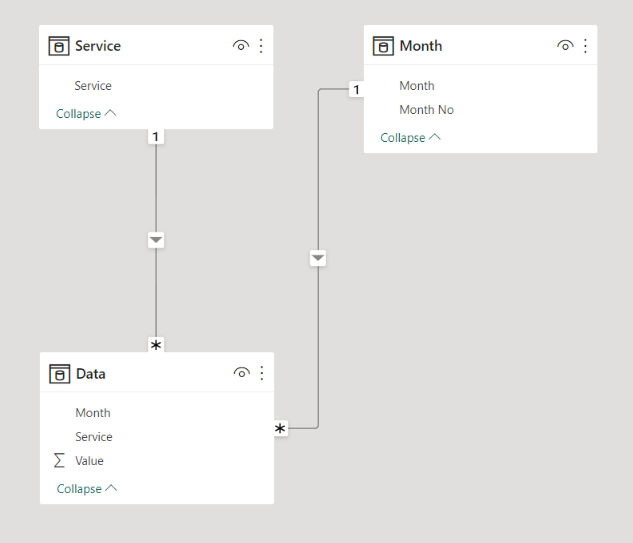
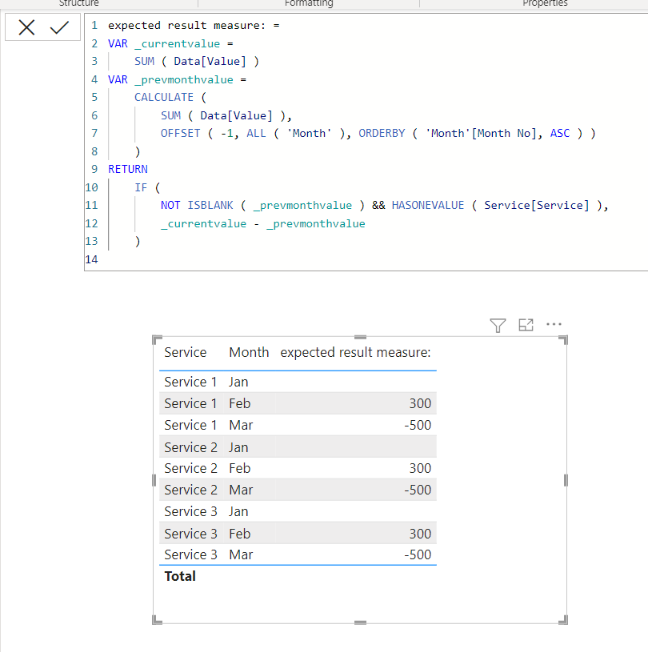
I am not sure how your datamodel looks like, but please check the below picture and the attached pbix file.


Jihwan_Kim_0-1673374793674.png


Jihwan_Kim_1-1673375012445.png


expected result measure: =
VAR _currentvalue =
    SUM ( Data[Value] )
VAR _prevmonthvalue =
    CALCULATE (
        SUM ( Data[Value] ),
        OFFSET ( -1, ALL ( 'Month' ), ORDERBY ( 'Month'[Month No], ASC ) )
    )
RETURN
    IF (
        NOT ISBLANK ( _prevmonthvalue ) && HASONEVALUE ( Service[Service] ),
        _currentvalue - _prevmonthvalue
    )


If this post helps, then please consider accepting it as the solution to help other members find it faster, and give a big thumbs up.


Click here to visit my LinkedIn page

Thanks for this, i will give it ago.


I haven't got a data model as you sugest, all of my data work is done in the transform section then i'm using the final appended and  merged data as my source data.


Why do we need a month number, I assume I need to add this to my data?


Regards

Colin

Hi,

Thank you for your message.

The reason why we need a month number column is that,


- Jan, Feb, and Mar has to be sorted by month number column, not by alphabetical order.

- we need to let Power BI know that "Feb" minus one is "Jan".


The month number column helps these kinds of sort-order-arrangement and calculations.


I hope this helps.

Thanks. 


If this post helps, then please consider accepting it as the solution to help other members find it faster, and give a big thumbs up.


Click here to visit my LinkedIn page

Helpful resources

Announcements
New to Fabric survey Carousel

New to Fabric Survey

If you have recently started exploring Fabric, we'd love to hear how it's going. Your feedback can help with product improvements.

Power BI DataViz World Championships carousel

Power BI DataViz World Championships - June 2026

A new Power BI DataViz World Championship is coming this June! Don't miss out on submitting your entry.

Join our Fabric User Panel

Join our Fabric User Panel

Share feedback directly with Fabric product managers, participate in targeted research studies and influence the Fabric roadmap.

March Power BI Update Carousel

Power BI Community Update - March 2026

Check out the March 2026 Power BI update to learn about new features.