cancel
Showing results for 
Search instead for 
Did you mean: 

The Power BI Data Visualization World Championships is back! Get ahead of the game and start preparing now! Learn more

Reply
Anonymous
Not applicable

Measure/ Column

Hi everyone,


I need your help in the following: 


I want to do another column /measure to have Opportunity X sum as 39486.96 and Opportunity Y sum as 60735.6, how can I achieve that? There are a lot of opportunities though not only X and Y.


Opportunity NameExpected Value CurrencyExpected Value

XUSD39486.96
XUSD39486.96
XUSD39486.96
XUSD39486.96
XUSD39486.96
XUSD39486.96
XUSD39486.96
YUSD60735.6
YUSD60735.6
YUSD60735.6
YUSD60735.6
YUSD60735.6
YUSD60735.6
YUSD60735.6


Thanks,

Amr

5 REPLIES 5
Anonymous
Not applicable

Hi @Anonymous ,


First of all, I want to know if the data you gave is the original data.

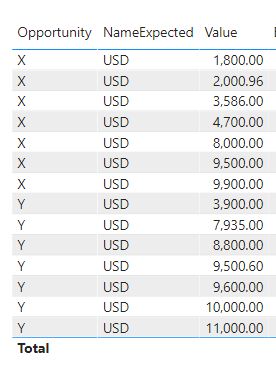
If it did not the original data, I made an attempt with the following data.


1.PNG

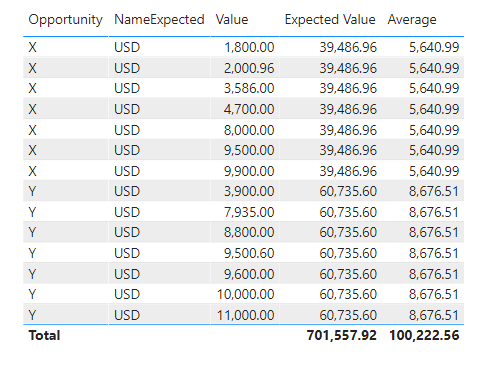
Expected Value = CALCULATE(SUM('Table'[Value]),ALLEXCEPT('Table','Table'[Opportunity  ]))
Average =CALCULATE(AVERAGE('Table'[Value]),ALLEXCEPT('Table','Table'[Opportunity  ]))


2.PNG

If it's still not the result you want, please share the raw data with me and let me know about your thoughts.

If this post helps, then please consider Accept it as the solution to help the other members find it more quickly.


Best Regards,
Community Support Team _ Polly

Greg_Deckler
Community Champion
Community Champion

@Anonymous If you need SUMIF, you can do it like:

SUMX(FILTER('Table',[Opportunity Name] = "X"),[Value])

Excel to DAX Translation - Microsoft Power BI Community


Follow on LinkedIn
@ me in replies or I'll lose your thread!!!
Instead of a Kudo, please vote for this idea
Become an expert!: Enterprise DNA
External Tools: MSHGQM
YouTube Channel!: Microsoft Hates Greg
Latest book!:
DAX For Humans

DAX is easy, CALCULATE makes DAX hard...
Sergione
Regular Visitor

Hello @Anonymous,  it seems that you're looking for an equivalemnt of Excel's SUMIF. Am I right?

I believe you'll find an answer after carefully reading this article - How CALCULATE works in DAX - SQLBI. I'm convinced that it will help you a lot in the future, so it definitely worth to invest some time in understading this material.

Good luck with learning DAX! And let us know if you still have doubts after reading it 🙂

amitchandak
Super User
Super User

@Anonymous , Not very clear

if you have Expected Value

then a measure

sumx(summarize(Table, Table[Opportunity Name], Table[Expected Value] ), [Expected Value])


If not then new column 

Expected Value = if([Opportunity Name] = "X" , 39486.96,60735.6)

Share with Power BI Enthusiasts: Full Power BI Video (20 Hours) YouTube
Microsoft Fabric Series 60+ Videos YouTube
Microsoft Fabric Hindi End to End YouTube
Anonymous
Not applicable

Thank you :)) , This one worked sumx(summarize(Table, Table[Opportunity Name], Table[Expected Value] ), [Expected Value]). The problem I couldnt calculate the average of this function.


Expected Value = if([Opportunity Name] = "X" , 39486.96,60735.6) --> this one assumes I only have to opportunity names, which is not the case.


I have multiple opportunity names, Expected Values. 

Helpful resources

Announcements
Power BI DataViz World Championships

Power BI Dataviz World Championships

The Power BI Data Visualization World Championships is back! Get ahead of the game and start preparing now!

December 2025 Power BI Update Carousel

Power BI Monthly Update - December 2025

Check out the December 2025 Power BI Holiday Recap!

FabCon Atlanta 2026 carousel

FabCon Atlanta 2026

Join us at FabCon Atlanta, March 16-20, for the ultimate Fabric, Power BI, AI and SQL community-led event. Save $200 with code FABCOMM.