Become a Certified Power BI Data Analyst!
Join us for an expert-led overview of the tools and concepts you'll need to pass exam PL-300. The first session starts on June 11th. See you there!
Get registered- Power BI forums
- Get Help with Power BI
- Desktop
- Service
- Report Server
- Power Query
- Mobile Apps
- Developer
- DAX Commands and Tips
- Custom Visuals Development Discussion
- Health and Life Sciences
- Power BI Spanish forums
- Translated Spanish Desktop
- Training and Consulting
- Instructor Led Training
- Dashboard in a Day for Women, by Women
- Galleries
- Webinars and Video Gallery
- Data Stories Gallery
- Themes Gallery
- Contests Gallery
- Quick Measures Gallery
- Notebook Gallery
- Translytical Task Flow Gallery
- R Script Showcase
- Ideas
- Custom Visuals Ideas (read-only)
- Issues
- Issues
- Events
- Upcoming Events
Power BI is turning 10! Let’s celebrate together with dataviz contests, interactive sessions, and giveaways. Register now.
- Power BI forums
- Forums
- Get Help with Power BI
- Desktop
- Re: How to do a count of a count?
- Subscribe to RSS Feed
- Mark Topic as New
- Mark Topic as Read
- Float this Topic for Current User
- Bookmark
- Subscribe
- Printer Friendly Page


- Mark as New
- Bookmark
- Subscribe
- Mute
- Subscribe to RSS Feed
- Permalink
- Report Inappropriate Content
How to do a count of a count?
OK, pretty simple question, I think. I have customers. They have invoices. Using Slicers, I can choose a customer, and show many invoices they have, or build a matrix to show each customer and how many thay have each.
I can choose a date range, and show how many total invoices were shipped within that range, with a matrix by customer.
What I want to show, however is how many customers ordered exactly 5 times, how many ordered exactly 4 times, how many ordered exactly three times, etc. within that date range.
I am not sure quite how to go about this in DAX. I can get specific if I need to, but I think just the general concept would be enough to get me where I need to be.
Thank for any assistance.
Phil
Solved! Go to Solution.


- Mark as New
- Bookmark
- Subscribe
- Mute
- Subscribe to RSS Feed
- Permalink
- Report Inappropriate Content
Try this Calculated Table
from the Modelling tab >>New Table
Table =
SUMMARIZE (
    SUMMARIZE (
        CustomerTable,
        CustomerTable[Customer Name],
        "Order_Count", COUNTROWS ( InvoiceTable )
    ),
    [Order_Count],
    "Count of Customers with", COUNT ( CustomerTable[Customer Name] )
)
Regards
Zubair
Please try my custom visuals


- Mark as New
- Bookmark
- Subscribe
- Mute
- Subscribe to RSS Feed
- Permalink
- Report Inappropriate Content
Hi,
Share some data and show the expected result.
Regards,
Ashish Mathur
http://www.ashishmathur.com
https://www.linkedin.com/in/excelenthusiasts/
- Mark as New
- Bookmark
- Subscribe
- Mute
- Subscribe to RSS Feed
- Permalink
- Report Inappropriate Content
| InvoiceTable | ||
| Invoice# | Customer# | Invoice Amount |
| 1001 | 4 | $ 637.97 |
| 1002 | 3 | $ 456.71 |
| 1003 | 1 | $ 619.04 |
| 1004 | 1 | $ 992.96 |
| 1005 | 3 | $ 987.20 |
| 1006 | 4 | $ 194.08 |
| 1007 | 4 | $ 35.97 |
| 1008 | 1 | $ 479.84 |
| 1009 | 1 | $ 929.18 |
| 1010 | 2 | $ 271.85 |
| 1011 | 3 | $ 288.53 |
| 1012 | 1 | $ 219.49 |
| CustomerTable | |
| Customer # | Customer Name |
| 1 | Joe |
| 2 | Fred |
| 3 | Mark |
| 4 | Nathan |
With this DAX: Orders_Count = Calculate(DISTINCTCOUNT(InvoiceTable[invoice#]))
I can get this result:
| Customer Name | Order_Count |
| Joe | 5 |
| Fred | 1 |
| Mark | 3 |
| Joe | 3 |
Now I want the Next Level:
| Count_Of_Customers_With | Order_Count |
| 1 | 1 |
| 2 | 3 |
| 1 | 5 |
If I know how to count the count, I should be able to figure out how to Slice and sort by count. For instance, Customer with most orders on top. Customers with 100 orders.
I am trying to wrap my head around the suggestion offered in the previous post. It is not quite gelling for me.
Thanx for any help.
- Mark as New
- Bookmark
- Subscribe
- Mute
- Subscribe to RSS Feed
- Permalink
- Report Inappropriate Content
Try this Calculated Table
from the Modelling tab >>New Table
Table =
SUMMARIZE (
    SUMMARIZE (
        CustomerTable,
        CustomerTable[Customer Name],
        "Order_Count", COUNTROWS ( InvoiceTable )
    ),
    [Order_Count],
    "Count of Customers with", COUNT ( CustomerTable[Customer Name] )
)
Regards
Zubair
Please try my custom visuals
- Mark as New
- Bookmark
- Subscribe
- Mute
- Subscribe to RSS Feed
- Permalink
- Report Inappropriate Content
Thank you. I was able to adapt that to my PBIX, and now I understand how Summarize works. Previous explanations were a little too generic to wrap my head around.
Thank You.
- Mark as New
- Bookmark
- Subscribe
- Mute
- Subscribe to RSS Feed
- Permalink
- Report Inappropriate Content
It works with the sample data
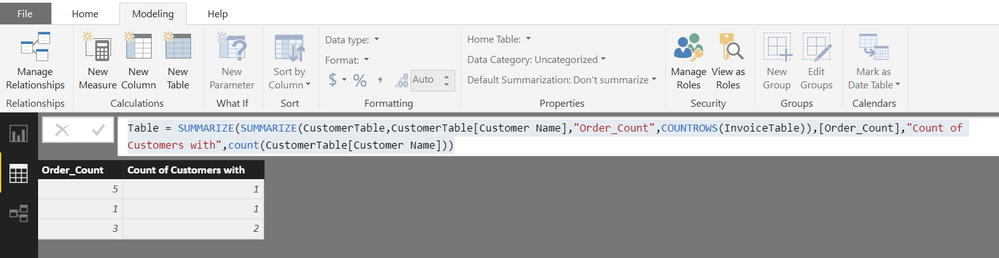
Regards
Zubair
Please try my custom visuals

- Mark as New
- Bookmark
- Subscribe
- Mute
- Subscribe to RSS Feed
- Permalink
- Report Inappropriate Content
This looks like a measure aggregation problem. See my blog article about that here: https://community.powerbi.com/t5/Community-Blog/Design-Pattern-Groups-and-Super-Groups/ba-p/138149
Follow on LinkedIn
@ me in replies or I'll lose your thread!!!
Instead of a Kudo, please vote for this idea
Become an expert!: Enterprise DNA
External Tools: MSHGQM
YouTube Channel!: Microsoft Hates Greg
Latest book!: Power BI Cookbook Third Edition (Color)
DAX is easy, CALCULATE makes DAX hard...

Helpful resources

Join our Fabric User Panel
This is your chance to engage directly with the engineering team behind Fabric and Power BI. Share your experiences and shape the future.

Power BI Monthly Update - June 2025
Check out the June 2025 Power BI update to learn about new features.

Fabric Community Update - June 2025
Find out what's new and trending in the Fabric community.

| User | Count |
|---|---|
| 84 | |
| 72 | |
| 68 | |
| 41 | |
| 35 |


| User | Count |
|---|---|
| 108 | |
| 56 | |
| 52 | |
| 48 | |
| 41 |


