Don't miss your chance to take the Fabric Data Engineer (DP-600) exam for FREE! Find out how by attending the DP-600 session on April 23rd (pacific time), live or on-demand.
Learn moreNext up in the FabCon + SQLCon recap series: The roadmap for Microsoft SQL and Maximizing Developer experiences in Fabric. All sessions are available on-demand after the live show. Register now
I want to count the # of times a text value is in a column, but when I filter those text values, that total count does not change. I have mutliple related columns and when I filter down the line it decreases the count of some of the first items.
Solved! Go to Solution.
Hi @Anonymous ,
I updated your sample pbix file(see the attachment), please check whether that is what you want. Please update the formula of measure [unfiltered_count] as below:
unfiltered_count =
VAR _species =
CALCULATETABLE (
VALUES ( 'plant_table'[Species] ),
FILTER (
'plant_table',
'plant_table'[Type] IN ALLSELECTED ( 'plant_table'[Type] )
)
)
RETURN
CALCULATE (
COUNT ( plant_table[Species] ),
FILTER ( ALL ( 'plant_table' ), 'plant_table'[Species] IN _species )
)
Best Regards
The current equation returns the total entries in the column rather than the # of times each values is repeated. I have three values, 'text1', 'text2', 'text3' and they all return the same total number. How could I each values # of occurences?
Hi @Anonymous ,
I'm not clear about your requirement, could you please provide some sample data in your tables (exclude sensitive data) with Text format and your expected result with backend logic and special examples. It is better if you can share a simplified pbix file. You can refer the following link to upload the file to the community. Thank you.
How to upload PBI in Community
Best Regards
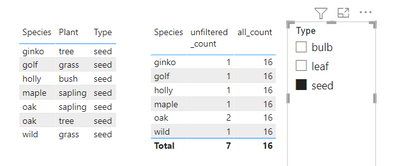
So this is the data normally
When I filter I want the count column to have the same numbers as if it were unfiltered, but the rows shown be filtered. This is the output I want.
This is the output I normally get
Hi @Anonymous ,
I updated your sample pbix file(see the attachment), please check whether that is what you want. Please update the formula of measure [unfiltered_count] as below:
unfiltered_count =
VAR _species =
CALCULATETABLE (
VALUES ( 'plant_table'[Species] ),
FILTER (
'plant_table',
'plant_table'[Type] IN ALLSELECTED ( 'plant_table'[Type] )
)
)
RETURN
CALCULATE (
COUNT ( plant_table[Species] ),
FILTER ( ALL ( 'plant_table' ), 'plant_table'[Species] IN _species )
)
Best Regards
If you have recently started exploring Fabric, we'd love to hear how it's going. Your feedback can help with product improvements.
A new Power BI DataViz World Championship is coming this June! Don't miss out on submitting your entry.
Experience the highlights from FabCon & SQLCon, available live and on-demand starting April 14th.
| User | Count |
|---|---|
| 47 | |
| 43 | |
| 40 | |
| 20 | |
| 15 |
| User | Count |
|---|---|
| 70 | |
| 67 | |
| 32 | |
| 27 | |
| 25 |