FabCon is coming to Atlanta
Join us at FabCon Atlanta from March 16 - 20, 2026, for the ultimate Fabric, Power BI, AI and SQL community-led event. Save $200 with code FABCOMM.
Register now!- Power BI forums
- Get Help with Power BI
- Desktop
- Service
- Report Server
- Power Query
- Mobile Apps
- Developer
- DAX Commands and Tips
- Custom Visuals Development Discussion
- Health and Life Sciences
- Power BI Spanish forums
- Translated Spanish Desktop
- Training and Consulting
- Instructor Led Training
- Dashboard in a Day for Women, by Women
- Galleries
- Data Stories Gallery
- Themes Gallery
- Contests Gallery
- QuickViz Gallery
- Quick Measures Gallery
- Visual Calculations Gallery
- Notebook Gallery
- Translytical Task Flow Gallery
- TMDL Gallery
- R Script Showcase
- Webinars and Video Gallery
- Ideas
- Custom Visuals Ideas (read-only)
- Issues
- Issues
- Events
- Upcoming Events
The Power BI Data Visualization World Championships is back! It's time to submit your entry. Live now!
- Power BI forums
- Forums
- Get Help with Power BI
- Desktop
- Dynamic Calculated Columns - M Query (advanced)
- Subscribe to RSS Feed
- Mark Topic as New
- Mark Topic as Read
- Float this Topic for Current User
- Bookmark
- Subscribe
- Printer Friendly Page

- Mark as New
- Bookmark
- Subscribe
- Mute
- Subscribe to RSS Feed
- Permalink
- Report Inappropriate Content
Dynamic Calculated Columns - M Query (advanced)
Guys,
I have a reconciliation script that I often use; it's essentially a FullOuterJoin between two tables (orange and green below). Once the data is loaded to Power BI, I then manually add several columns (in grey below) to see if the values match.
Example:
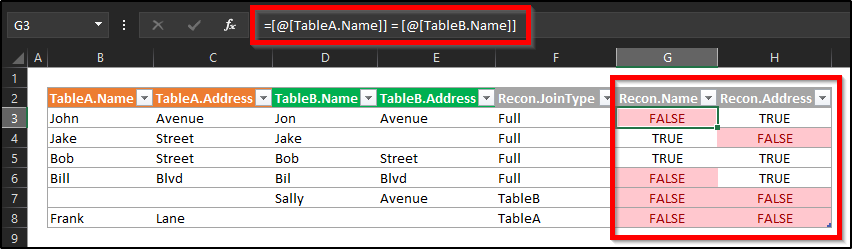
I would like to automate the creation of the columns highlighted in the red box. Obviously the solution would need to be dynamic, i.e., should TableA or TableB change in column count, then so would the columns in the red box.
Thanks,
Simon
Solved! Go to Solution.


- Mark as New
- Bookmark
- Subscribe
- Mute
- Subscribe to RSS Feed
- Permalink
- Report Inappropriate Content
Oh, thanks Simon... I would have thought that you know me by now:
let
    Source = Table.FromRows(Json.Document(Binary.Decompress(Binary.FromText("i45W8srPyFPSUXIsS80rTQUysvJRuG6lOTlKsTpAdYnZIH5wSVFqagmQAeWDUGwsAA==", BinaryEncoding.Base64), Compression.Deflate)), let _t = ((type text) meta [Serialized.Text = true]) in type table [TableA.Name = _t, TableA.Adress = _t, TableB.Name = _t, TableB.Adress = _t, Recon.JoinType = _t]),
    FetchColNames = Table.ColumnNames(Source),
    ConvertToTable = Table.FromList(FetchColNames, Splitter.SplitByNothing(), null, null, ExtraValues.Error),
    Duplicate = Table.DuplicateColumn(ConvertToTable, "Column1", "Column1 - Copy"),
    SplitCol = Table.SplitColumn(Duplicate, "Column1 - Copy", Splitter.SplitTextByDelimiter(".", QuoteStyle.Csv), {"Column1 - Copy.1", "Column1 - Copy.2"}),
    Group = Table.Group(SplitCol, {"Column1 - Copy.2"}, {{"Count", each Table.RowCount(_), type number}, {"All", each _[Column1], type table}}),
    Rename = Table.RenameColumns(Group,{{"Column1 - Copy.2", "PairName"}}),
    TableOfPairs = Table.Buffer(Table.SelectRows(Rename, each ([Count] = 2))),
    Compare = Table.AddColumn(Source, "Comparison", each List.Transform(TableOfPairs[All], (x) => Record.Field(_, x{0}) = Record.Field(_, x{1}))),
    CreateTable = Table.AddColumn(Compare, "Custom", each #table(TableOfPairs[PairName], {[Comparison]})),
    DynamicExpansion = Table.ExpandTableColumn(CreateTable, "Custom", TableOfPairs[PairName]),
    Cleanup = Table.RemoveColumns(DynamicExpansion,{"Comparison"})
in
    Cleanup
No pivoting, so it should be fast.
Imke Feldmann (The BIccountant)
If you liked my solution, please give it a thumbs up. And if I did answer your question, please mark this post as a solution. Thanks!
How to integrate M-code into your solution -- How to get your questions answered quickly -- How to provide sample data -- Check out more PBI- learning resources here -- Performance Tipps for M-queries

- Mark as New
- Bookmark
- Subscribe
- Mute
- Subscribe to RSS Feed
- Permalink
- Report Inappropriate Content
If it's advanced M code then your best bet is probably @ImkeF!
Follow on LinkedIn
@ me in replies or I'll lose your thread!!!
Instead of a Kudo, please vote for this idea
Become an expert!: Enterprise DNA
External Tools: MSHGQM
YouTube Channel!: Microsoft Hates Greg
Latest book!: DAX For Humans
DAX is easy, CALCULATE makes DAX hard...
- Mark as New
- Bookmark
- Subscribe
- Mute
- Subscribe to RSS Feed
- Permalink
- Report Inappropriate Content
- Mark as New
- Bookmark
- Subscribe
- Mute
- Subscribe to RSS Feed
- Permalink
- Report Inappropriate Content
Yes we can, I call it "Invoking @ImkeF" 🙂
Follow on LinkedIn
@ me in replies or I'll lose your thread!!!
Instead of a Kudo, please vote for this idea
Become an expert!: Enterprise DNA
External Tools: MSHGQM
YouTube Channel!: Microsoft Hates Greg
Latest book!: DAX For Humans
DAX is easy, CALCULATE makes DAX hard...
- Mark as New
- Bookmark
- Subscribe
- Mute
- Subscribe to RSS Feed
- Permalink
- Report Inappropriate Content
Oh, thanks Simon... I would have thought that you know me by now:
let
    Source = Table.FromRows(Json.Document(Binary.Decompress(Binary.FromText("i45W8srPyFPSUXIsS80rTQUysvJRuG6lOTlKsTpAdYnZIH5wSVFqagmQAeWDUGwsAA==", BinaryEncoding.Base64), Compression.Deflate)), let _t = ((type text) meta [Serialized.Text = true]) in type table [TableA.Name = _t, TableA.Adress = _t, TableB.Name = _t, TableB.Adress = _t, Recon.JoinType = _t]),
    FetchColNames = Table.ColumnNames(Source),
    ConvertToTable = Table.FromList(FetchColNames, Splitter.SplitByNothing(), null, null, ExtraValues.Error),
    Duplicate = Table.DuplicateColumn(ConvertToTable, "Column1", "Column1 - Copy"),
    SplitCol = Table.SplitColumn(Duplicate, "Column1 - Copy", Splitter.SplitTextByDelimiter(".", QuoteStyle.Csv), {"Column1 - Copy.1", "Column1 - Copy.2"}),
    Group = Table.Group(SplitCol, {"Column1 - Copy.2"}, {{"Count", each Table.RowCount(_), type number}, {"All", each _[Column1], type table}}),
    Rename = Table.RenameColumns(Group,{{"Column1 - Copy.2", "PairName"}}),
    TableOfPairs = Table.Buffer(Table.SelectRows(Rename, each ([Count] = 2))),
    Compare = Table.AddColumn(Source, "Comparison", each List.Transform(TableOfPairs[All], (x) => Record.Field(_, x{0}) = Record.Field(_, x{1}))),
    CreateTable = Table.AddColumn(Compare, "Custom", each #table(TableOfPairs[PairName], {[Comparison]})),
    DynamicExpansion = Table.ExpandTableColumn(CreateTable, "Custom", TableOfPairs[PairName]),
    Cleanup = Table.RemoveColumns(DynamicExpansion,{"Comparison"})
in
    Cleanup
No pivoting, so it should be fast.
Imke Feldmann (The BIccountant)
If you liked my solution, please give it a thumbs up. And if I did answer your question, please mark this post as a solution. Thanks!
How to integrate M-code into your solution -- How to get your questions answered quickly -- How to provide sample data -- Check out more PBI- learning resources here -- Performance Tipps for M-queries
- Mark as New
- Bookmark
- Subscribe
- Mute
- Subscribe to RSS Feed
- Permalink
- Report Inappropriate Content
Thanks Imke!
Super impressive - for each row, creating a list of a list of pairs that are used as variables against the main table. I've never used Record.Field before so that was nice to see!
Simon
Helpful resources

Power BI Dataviz World Championships
The Power BI Data Visualization World Championships is back! It's time to submit your entry.

Power BI Monthly Update - January 2026
Check out the January 2026 Power BI update to learn about new features.

FabCon Atlanta 2026
Join us at FabCon Atlanta, March 16-20, for the ultimate Fabric, Power BI, AI and SQL community-led event. Save $200 with code FABCOMM.

| User | Count |
|---|---|
| 67 | |
| 51 | |
| 38 | |
| 26 | |
| 22 |


| User | Count |
|---|---|
| 135 | |
| 116 | |
| 54 | |
| 37 | |
| 31 |


