Don't miss your chance to take the Fabric Data Engineer (DP-700) exam on us!
Learn moreNext up in the FabCon + SQLCon recap series: The roadmap for Microsoft SQL and Maximizing Developer experiences in Fabric. All sessions are available on-demand after the live show. Register now
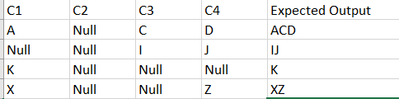
Sample data:
For example, I want to concatenate C1,C2,C3,C4 columns and I don't want to include Null values in the Output Column.
Thanks in advance.
Solved! Go to Solution.
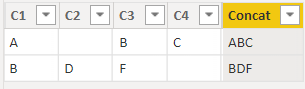
I would do that kind of thing in the query editor, but here is a DAX column expression you can use. A virtual table is created with { }, filtered to remove blanks, and then the results are concatenated with no delimiter. Replace T1 with your actual table name.
Concat =
VAR ValuesAsTable =
FILTER ( { T1[C1], T1[C2], T1[C3], T1[C4] }, [Value] <> "" )
RETURN
CONCATENATEX ( ValuesAsTable, [Value], "" )
Pat
I would do that kind of thing in the query editor, but here is a DAX column expression you can use. A virtual table is created with { }, filtered to remove blanks, and then the results are concatenated with no delimiter. Replace T1 with your actual table name.
Concat =
VAR ValuesAsTable =
FILTER ( { T1[C1], T1[C2], T1[C3], T1[C4] }, [Value] <> "" )
RETURN
CONCATENATEX ( ValuesAsTable, [Value], "" )
Pat
You can add a new column with the code below:
Expected Output = Data[C1]&Data[C2]&Data[C3]&Data[C4]
If you have recently started exploring Fabric, we'd love to hear how it's going. Your feedback can help with product improvements.
A new Power BI DataViz World Championship is coming this June! Don't miss out on submitting your entry.
Share feedback directly with Fabric product managers, participate in targeted research studies and influence the Fabric roadmap.
| User | Count |
|---|---|
| 9 | |
| 6 | |
| 3 | |
| 2 | |
| 1 |
| User | Count |
|---|---|
| 21 | |
| 14 | |
| 9 | |
| 5 | |
| 5 |